Horse Racing Going Conditions UK — Reading Soft, Heavy and Firm
 Available in US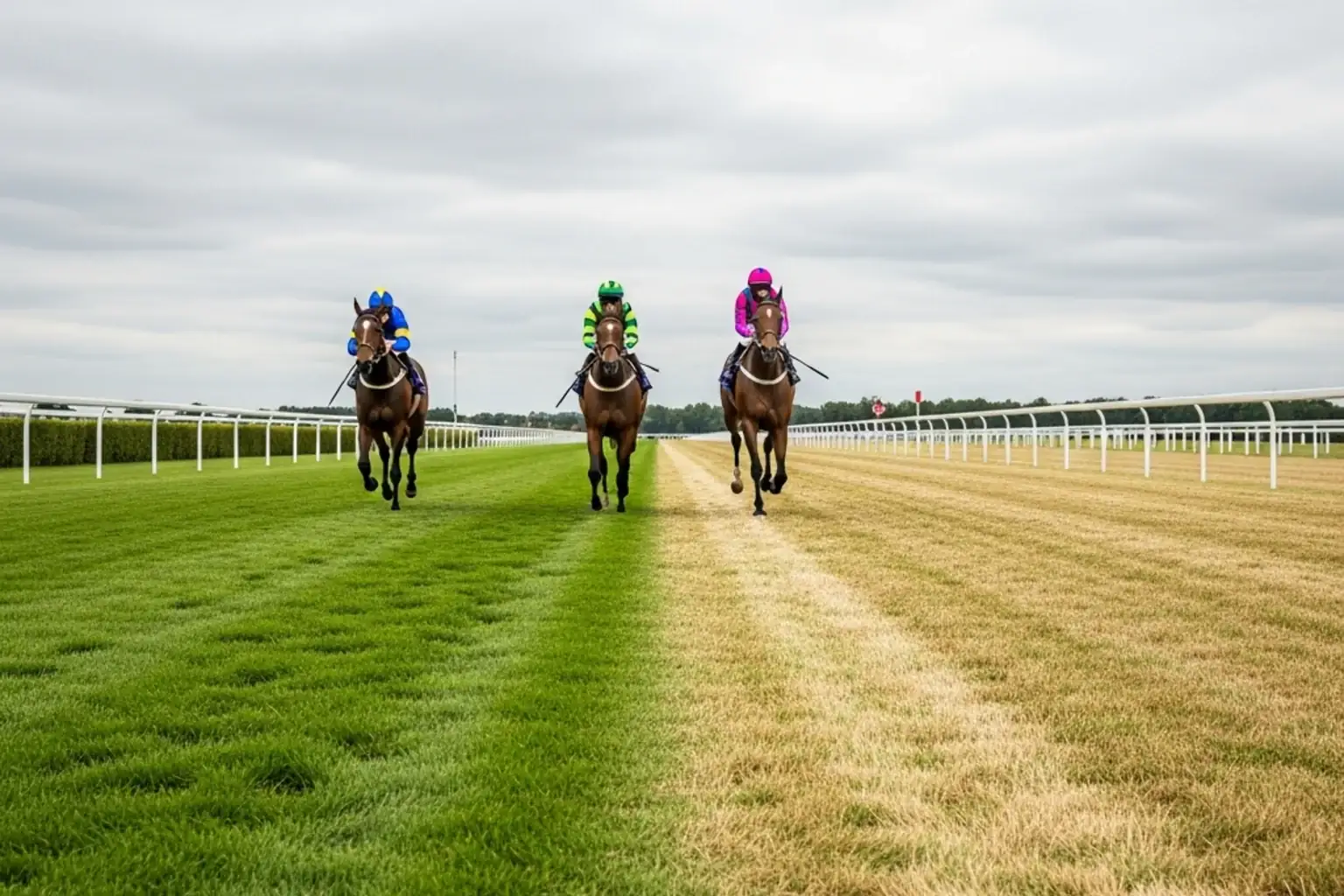
The variable that overrides almost everything else
The single bet I have spent more time regretting than any other was a 6/4 short-priced favourite at Newbury in October a few years back. The horse had won twice in three runs, the form figures were excellent, the trainer was in good form, the jockey was the right one. I missed the going call. The morning racecard showed “good to soft”. By the time the race was off, three hours of steady rain had turned the ground genuinely soft. The horse had never raced on softer than good. It plodded round in midfield, finished sixth of fourteen, and never threatened. The form lines all suggested the bet. The going broke it.
Going is the most important single variable in UK turf racing. It changes which horses can produce their form, it changes time figures, it changes pace patterns, it changes which trainers and jockeys have a meaningful advantage. The BHA’s 2025 Racing Report identified 1,423 high-rated Flat horses (90+ performance figure) in training in the UK — and the going call on the day of the race is what determines which of those horses can actually deliver to their figure. Reading the going accurately, including how it is changing through the day, is one of the highest-value form-reading habits a UK punter can develop.
This piece walks through the going scale, the GoingStick measurement, the horse-type implications, and the watering practices that move the call between morning and race time.
Read our detailed review of Horse Racing Jobs and Economic Footprint UK — Behind the Betting Industry.
The going scale — six grades on UK turf
UK turf racing uses a six-grade going scale, set by the clerk of the course and based on a combination of GoingStick readings and visual assessment. Each grade represents a meaningful step in surface character, and horses’ ability to handle each grade varies considerably.
Firm. The driest end of the scale. Ground that has hardened in extended dry conditions. Time figures are typically fast on firm ground, but the surface punishes horses with delicate joints or limbs and many trainers prefer not to run on it for welfare reasons. Firm is increasingly rare in modern UK racing because clerks tend to water aggressively in dry spells to keep the going at good to firm or good.
Good to firm. The grade just below firm. Still fast and free-draining, but with some give in the surface. Most summer Flat racing in the UK runs on good to firm in extended dry periods. Speed-types and efficient-stride horses produce their best form on this grade.
Good. The middle of the scale. A surface with moderate give, allowing horses to gallop freely without significant resistance. Good is the default summer surface in temperate UK conditions and is the grade most horses produce their best form on. Time figures on good are the standard reference for most Flat performance ratings.
Good to soft. The grade between good and soft. The surface has noticeable give and the times are typically a couple of seconds slower than on good. The transition between good to soft and soft is the most consequential boundary on the scale for many horses — some that handle good to soft cannot handle soft.
Soft. The surface has substantial give. Horses’ hooves leave clear impressions and the going slows times by several seconds compared with good. Stamina-types and high-knee-action horses tend to dominate. Speed-types struggle. Many summer favourites have lost on soft ground in conditions that would not have been called soft 30 years ago — the scale has effectively shifted as definitions have tightened.
Heavy. The wettest grade. Heavy ground produces times that are 5-10 seconds slower than good across most distances. Only horses with genuine stamina and the right physical action complete races without distress, and the field positions late in heavy races often bear no resemblance to the prior form lines. Heavy ground produces the highest variance in UK turf racing — favourites win less often and unexpected results are more common.
The Irish addition. Irish racing adds a grade — “yielding” — between good to soft and soft. The IRE yielding grade roughly corresponds to a softer good to soft on UK turf. Form from Irish yielding ground reads as closer to soft than to good to soft when transferred to UK racing analysis.
GoingStick measurement — the numerical layer
The GoingStick is a penetrometer device introduced widely across UK racing in the 2000s to provide a numerical measurement to support the official going call. The instrument is pushed into the turf at multiple points around the course, and the resistance produces a numerical reading that the clerk uses alongside visual assessment.
The numerical scale. GoingStick readings of 9.0-10.0 indicate firm ground. 7.0-8.5 is good to firm. 6.5-7.5 is good. 5.5-6.5 is good to soft. 4.5-5.5 is soft. Below 4.5 is heavy. The grades overlap at the boundaries because the GoingStick reading is one input alongside the clerk’s visual assessment.
The advantages of GoingStick. The numerical reading is more consistent than verbal descriptions. Two clerks at different courses making the same “good to soft” call may be describing meaningfully different surfaces — the GoingStick reading clarifies the actual condition. A “good to soft, GoingStick 6.5” call is closer to good than to soft. A “good to soft, GoingStick 5.5” call is closer to soft than to good.
The form-reading implication. When historic form lines include the GoingStick reading alongside the official going, the form reads more cleanly. A horse with strong form on “good to soft, GoingStick 5.8” tells you the horse handles softer ground than a horse with strong form on “good to soft, GoingStick 6.4”. The two horses might both be described as good-to-soft specialists, but their actual preferences differ.
The limitations. The GoingStick measures resistance to penetration but does not capture every aspect of surface character. Cut up turf with significant divots can ride differently from intact turf at the same reading. Cold winter turf rides differently from warm turf at the same reading. The clerk’s visual assessment still matters and the GoingStick supplements rather than replaces it.
Old-style “firm to good” calls have largely disappeared from official going language because the GoingStick reading clarifies which side of the boundary a surface actually sits on. The 87.6 per cent of UK races starting within two minutes of advertised time in Q1 2025 (up from 79.2 per cent in 2024) reflects the broader operational tightening in UK racing, of which standardised going measurement is part.
Horse types and going preferences
Horses develop going preferences early in their careers and typically retain them throughout. The preference traces back to physical action — the way the horse picks up its feet, the angle of the joints, the stride length and frequency — and to underlying physiology including muscle composition and stamina.
Soft-ground specialists. Horses with a high knee action — picking the feet up sharply over the surface — handle soft and heavy ground well because the stride pushes through the give in the surface. The action looks slightly ungainly on firm ground but becomes efficient on soft. Soft-ground specialists often have stamina built in, partly because the soft surface itself demands stamina to complete the trip, and partly because their physical profile suits the staying programme. Many summer disappointments on quicker ground turn out to be soft-ground specialists running on the wrong surface.
Firm-ground horses. Horses with a low, efficient stride pattern — minimal vertical movement, long horizontal stride, fast cadence — produce their best form on firm and good to firm ground. The efficiency that wins on firm ground is wasted on soft, where the surface demands a different action that the firm-ground horse cannot deliver. Firm-ground horses often have a clean, fast galloping action that looks more athletic than the soft-ground horses on a parade ring inspection — but the action only works on the right surface.
Versatile types. Some horses handle a wide going range — typically those with balanced physical action that adapts to surface conditions. These horses are the most reliable in handicap programming because the trainer can target races without obsessing about going calls. The most successful handicappers in UK racing tend to be the versatile types who can run consistently across the full going scale.
Pedigree as a partial guide. Sire and dam form can suggest a horse’s going preference before it has raced enough to establish its own. Sons and daughters of stallions with strong soft-ground records tend to inherit that preference. The signal is not deterministic — siblings can have opposing preferences — but it is a useful input for two-year-old debut runs where there is no own form to read.
The form-reading practice. Look at the horse’s form lines and identify which grades it has produced its best runs on. Three good runs on soft and three poor runs on good tell you the horse needs soft. The reverse pattern tells you it needs faster going. Cross-reference with today’s call. If today’s going matches the horse’s strong-form grade, the form is likely predictive. If today’s grade is one the horse has run poorly on, the bet carries additional risk.
Find the best options for best betting horse racing.
Watering and irrigation — when the morning going moves
UK course managers actively manage the going. Watering is used aggressively in dry conditions to keep the surface from going too quick. The decision to water (or not water) is taken by the clerk of the course based on weather forecasts, the field declared, and the overall going philosophy of the venue. Watering announcements are published in advance and affect morning prices on horses with strong going preferences.
Watering patterns. Most UK courses water overnight when conditions allow — the surface absorbs the water gradually and the morning ground is softer than it would have been without watering. Courses water selectively rather than uniformly, so going can vary by a quarter or half a grade across different parts of the same track.
The morning-to-race window. The going call published on the morning racecard is the assessment at the time of publication. By race time, several hours later, the surface may have changed — drying out in warm conditions, softening further if rain has fallen. Clerks update the going call when conditions change materially, and the updated call is published before each race. Reading the day’s going update is part of the discipline of taking morning prices versus waiting for SP.
Unannounced changes. Sometimes the going changes between race-time updates without an announcement. A heavy shower between race 2 and race 3 can soften the ground noticeably for races 4 and 5 without a formal call update. Trainers and on-course connections see the change before it filters through to the official update. The morning markets do not always catch up immediately, and there can be a window of mispriced selections in the interval between the actual change and the market response.
Watering controversy. Watering decisions occasionally produce friction between clerks and connections. A clerk watering before a card produces softer going than natural conditions would have, and trainers running firm-ground specialists may feel their horses have been disadvantaged. The decisions sit within the clerk’s discretion under BHA rules. For more on how going interacts with course-specific characteristics, the UK racecourses guide covers track-specific factors including drainage and watering practice.
Going as a genuine punting edge
The disciplined punter treats going as a primary form-reading variable rather than a tiebreaker. The standard workflow. Check the going on the morning racecard for every race you are considering. Cross-reference each horse’s form lines against today’s going call. Identify which horses’ best form has come on today’s grade. Treat those horses’ form as the most reliable read; treat other horses’ form as carrying additional going risk that you need to discount. Watch the going updates through the day for material changes that affect the call. Read the GoingStick number alongside the verbal description for finer resolution. The going variable explains more apparently inexplicable losses by short-priced favourites than any other single factor in UK racing. The punter who reads the going accurately captures an edge that most casual bettors miss entirely.
Can a horse’s pedigree predict its going preference?
Pedigree provides a useful partial signal, particularly for unraced or lightly raced horses. Sires with strong records on specific going grades tend to produce offspring with similar preferences, though the signal is not deterministic — siblings can have opposing preferences. The pedigree information is most valuable on two-year-old debut runs where no own form is available; once a horse has run several times on different grades, its own form lines become the more reliable guide.
How accurate is the GoingStick compared with old ‘firm to good’ calls?
The GoingStick provides numerical consistency that pre-2000s verbal calls lacked. Two clerks giving the same verbal call could be describing materially different surfaces, while the GoingStick reading clarifies the actual condition. The instrument has limitations — it measures penetration resistance but does not capture every surface characteristic — but the numerical reading alongside the official going description gives the cleanest read on UK turf going currently available.
Written by the editors at Best Betting Horse Racing.