Horse Racing Bet Types UK — Win, Each-Way, Forecast and Multiples Explained
 Available in US
Table of Contents
- Why Most Punters Leave Money on the Table
- Win Betting — The Foundation of Every Racing Stake
- Each-Way Betting — Two Bets in One Slip
- Extra Places — The Edge Hiding in Festival Handicaps
- Forecasts and Tricasts — Predicting the Exact Finish
- Accumulators and Multiples — Chasing the Big Return
- Lucky 15, Yankee and the Combination Family
- Tote Pool Betting — When the Crowd Sets the Price
- Specials and Without Bets — Markets Beyond the Winner
- Rule 4 and Non-Runners — What Happens When a Horse Drops Out
- Matching the Bet Type to the Race
Why Most Punters Leave Money on the Table
I spent the first two years of my racing career placing nothing but win singles. Flat season, jumps, midweek cards at Wolverhampton — always the same slip: pick a horse, back it to win, move on. It took a losing run on a string of 5/2 favourites at Cheltenham before I sat down with a spreadsheet and realised that a single bet type was costing me the flexibility to extract value from different market conditions. That lesson reshaped everything.
UK betting turnover on horse racing dropped 12.8% between 2023 and 2025, yet the range of wagers available to punters has never been wider. Win, each-way, forecast, tricast, Lucky 15, Tote pools, specials — there are more than a dozen distinct formats, each suited to a specific scenario, field size and risk appetite. The problem is that most bettors default to one or two familiar options and never interrogate the maths behind the rest.
This guide walks through every major bet type you can place on UK racing, with the calculation that underpins each one. I am not going to tell you which wager to use today — that depends on the race. What I will do is show you the mechanics, so you can judge for yourself when a forecast beats a win single and when a Lucky 15 is just an expensive way to donate money to a bookmaker. Numbers first, opinions second.
Check out our guide on Horse Racing Betting Apps UK — What to Check Before You Download as well.
Win Betting — The Foundation of Every Racing Stake
A friend once told me he avoided win singles because they were “too simple.” He was right about the simplicity — and completely wrong about the implication. A win bet is the cleanest expression of an opinion on a horse race: your selection finishes first, you collect; it does not, you lose your stake. No conditions, no partial payouts, no layers of small print. That clarity is exactly what makes it the right starting point for any serious bettor.
The return on a win bet is calculated by multiplying your stake by the odds, then adding your original stake back. Place a tenner on a horse at 5/1 fractional odds and you receive £50 in profit plus your £10 stake — £60 total. The same bet expressed in decimal odds is 6.0: £10 x 6.0 = £60. Decimal notation already includes the stake, which is why it is the preferred format on exchanges and across continental Europe.
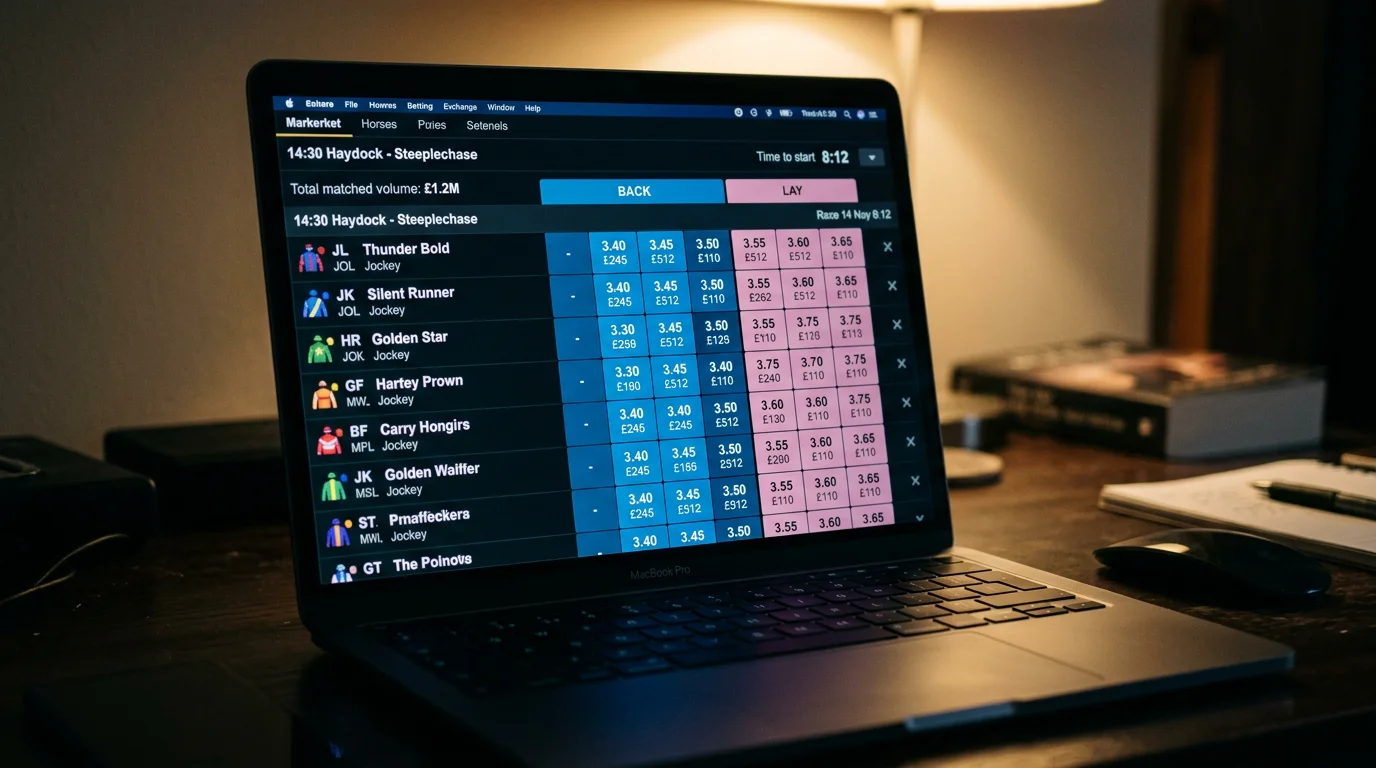
One detail that separates experienced punters from casual ones is the distinction between early price and Starting Price. Early price is the odds available when the market opens — sometimes the evening before — while SP is the industry-returned price at the moment the race begins. If you take an early price of 5/1 and the horse drifts to 7/1 by the off, you are stuck at 5/1 unless you have Best Odds Guaranteed, a concession that pays the higher of the two. Conversely, if your selection shortens from 5/1 to 3/1, BOG does not matter because you already hold the better number.
The practical question is when to lock in an early price and when to wait. Horses that attract late support — so-called “steamers” — typically shorten, which means the early price was your best chance. Drifters, whose odds lengthen as the off approaches, signal money moving away. Tracking these movements is not guesswork; it is a reading of market sentiment, and it feeds directly into the value assessment that separates profitable bettors from the rest. Win betting demands discipline in fields of twelve or more, but the simplicity of the payout means no hidden margin is layered into place terms or combination multipliers.
Each-Way Betting — Two Bets in One Slip
The first each-way bet I ever placed was on a 20/1 outsider in a Newbury handicap. It finished third. I was delighted to get paid — and then confused when the return was not what I expected. Each-way is not a single bet; it is two separate bets of equal stake. One bet is on the horse to win, the other is on the horse to finish in the places. A £5 each-way wager costs £10 total. Understanding that split is the first step toward deciding whether each-way value exists.
The place part of your bet pays at a fraction of the win odds, determined by the number of runners and the type of race. In a non-handicap with eight or more runners, bookmakers typically pay three places at one-fifth of the win odds. In a handicap with sixteen or more runners, you get four places at one-quarter of the odds. Smaller fields — five to seven runners — usually pay two places at one-quarter. Races with four runners or fewer are win-only; each-way is not offered.
Here is a concrete example. You back a horse at 10/1 each-way, £10 total (£5 win, £5 place), in a sixteen-runner handicap. If the horse wins, you receive £50 profit on the win part plus £12.50 profit on the place part (10/1 at one-quarter = 5/2, so £5 x 2.5 = £12.50), plus both stakes back — £82.50 total. If the horse finishes second, third or fourth, you lose the £5 win stake but collect £12.50 profit plus your £5 place stake — £17.50 back from a £10 outlay. If the horse finishes fifth or worse, you lose the full £10.
The breakeven question is critical and too often ignored. On a standard three-place race at one-fifth odds, an each-way bet on a horse at 4/1 returns only £4 on the place part for a £5 stake — you need the horse to win to make profit, which defeats the purpose of going each-way in the first place. The general threshold where each-way starts to generate positive expectation on the place portion alone is around 5/1 in a three-place race and 4/1 in a four-place handicap. Below those odds, a win single is almost always cleaner.
Where each-way punting genuinely shines is in large-field handicaps at festivals. Sixteen to twenty runners, place terms at one-quarter odds, plus the possibility of Extra Places promotions extending the payout to fifth or sixth — that combination can create scenarios where the place portion alone offers value. A survey of UK betting behaviour found that 65% of punters would refuse to hand over financial documents when asked for affordability checks, which suggests a significant portion of regular each-way players operate by instinct rather than analysis. Running the breakeven calculation before you write the slip is the simplest improvement most bettors can make.
Each-way is not inherently better or worse than a win single. It is a different tool. The place leg insures you against near-misses, but the insurance premium — doubling your stake — means you need the maths to justify it. When it works, it is one of the most satisfying structures in racing. When it does not, it is an expensive habit disguised as caution. For a full breakdown of each-way place terms, dead-heat rules and Rule 4 deductions, the dedicated guide covers every edge case.
Extra Places — The Edge Hiding in Festival Handicaps
Royal Ascot drew five million ITV viewers in 2025, and a good chunk of them were backing horses each-way in feature handicaps. What most did not realise is that bookmakers routinely extend the number of places paid on those exact races — and that extension shifts the expected value calculation considerably.
Extra Places is a promotional mechanic where a bookmaker pays out on, say, five or six places instead of the standard four. The place odds remain the same (one-quarter in a big handicap), but the probability of landing a place payout rises. If a race has twenty runners and standard terms pay four places, your horse has roughly a 20% chance of placing at random. Extend to six places and that probability climbs to 30%. The odds have not changed, but the likelihood of collecting has — and that gap between the unchanged odds and the improved probability is where edge sits.
I keep a separate log of Extra Places races and the results are striking. Over a season of festival handicaps, backing every qualifier each-way at the best available Extra Places terms produced a higher place-strike rate than the standard market by a margin that was not marginal. The key is selectivity: Extra Places are most commonly offered on the showpiece handicaps — the Cesarewitch, the Cambridgeshire, the big Saturday ITV races — where bookmakers use the promotion to attract volume. Fields of sixteen to twenty-four runners with five or six places paid at one-quarter odds create a genuine structural advantage.
Do not treat Extra Places as an afterthought. Check before you bet, not after. If one operator is paying five places and another is paying four on the same race, backing with the first is not loyalty — it is arithmetic.
Discover everything about best betting horse racing here.
Forecasts and Tricasts — Predicting the Exact Finish
There is a race that haunts every forecast bettor. Mine was a novice hurdle at Uttoxeter where I had the first two home in the right order at 8/1 and 14/1 — except I had placed a win single on the shorter-priced horse instead. The forecast dividend paid over £90 to a £1 stake. That was the day I started taking these markets seriously.
A straight forecast requires you to name the first and second finishers in the exact order. Get it right and the payout is calculated via the Computer Straight Forecast formula, which factors in the SP of both selections and the overall shape of the market. There is no fixed odds ticket; the dividend is declared after the race based on a mathematical formula maintained by the British Horseracing Authority. A reverse forecast covers both possible orders — your two selections finishing first-second or second-first — but it costs twice the unit stake because it is, in effect, two straight forecasts.
A tricast extends the logic to three horses: first, second and third in exact order. The payouts can be enormous because you are predicting three finishing positions, and the Computer Tricast formula amplifies the dividend when the SP of each selection is large. In a sixteen-runner handicap, a tricast of three 10/1 shots can return several hundred pounds to a £1 unit.
The question I get asked most often is when forecasts and tricasts are worth the additional difficulty. Field size is the deciding variable. In a five-runner race, the probability of nailing the first two in order is roughly 1 in 20 — manageable. In a twenty-runner handicap, that probability falls below 1 in 380 for a straight forecast and below 1 in 6,840 for a tricast. The dividend increases to compensate, but the variance is brutal. My own rule is straightforward: forecasts work best in fields of six to ten runners where form narrows the likely principals to three or four. Above twelve runners, the market becomes too noisy for reliable forecast betting unless you have a very strong form read on two specific animals.
One tactical point worth noting: bookmakers also offer fixed-odds forecasts, sometimes at prices that deviate significantly from what the Computer Forecast would return. Comparing the fixed price to an estimate of the CSF payout can reveal whether the bookmaker is offering value or clawing margin.
Accumulators and Multiples — Chasing the Big Return
I have a mate who texts me every Saturday with a five-fold accumulator and a screenshot of the potential return. It is always a life-changing number — £800 from a fiver, £2,000 from a tenner — and it almost never lands. He has been doing this for three years. Accumulators are the most seductive bet type in racing, and the one most likely to drain your bankroll over time.
A double links two selections: both must win for the bet to pay. The return from the first winner rolls onto the second as the new stake, creating a compounding effect. A treble extends to three selections, and an accumulator — commonly called an acca — chains four or more. The appeal is obvious: a four-fold of 3/1 shots returns £255 on a £1 stake. The catch is equally clear: the probability of four independent 3/1 shots all winning is roughly 1.5%, or about one in sixty-six attempts.
The maths works against you in a way that is not immediately visible. Each selection added to the accumulator multiplies not just the potential return but also the bookmaker’s margin. If each leg carries an overround of 5%, a four-fold compounds that to roughly 21.5% cumulative margin — nearly four and a half times the edge on a single. Over 80% of bets placed during the 2024 Cheltenham Festival came through mobile, and accumulators are the bet type that mobile interfaces are optimised to encourage. Quick picks, bonus boosts, “add to acca” buttons — all of these drive volume toward the format with the highest inherent house edge.
That said, multiples are not irrational in every scenario. Doubles and trebles on short-priced runners in small fields — where the probability of each leg winning is genuinely high — can produce reasonable returns at moderate risk. A double on two 6/4 shots carries roughly a 25% probability of landing, and the combined odds of 15/4 reflect that fairly. The distortion begins when you extend beyond three or four legs, because each additional selection compounds risk faster than it compounds reward.
If you want to use accumulators, apply one rule: never stake money on a multiple that you would not stake individually on each leg as a single. If you would not back leg three at those odds on its own merits, it does not belong in the chain. ITV 7 — the free-to-enter competition where you pick the winner of seven ITV races — is a popular accumulator-style format at festivals, but it is a recreational game with a fixed prize pool, not a controlled bet. Treat it accordingly.
Lucky 15, Yankee and the Combination Family
The day I placed my first Lucky 15 was also the day I discovered I did not fully understand what I had just bought. Four selections, fifteen bets, and a stake that was fifteen times the unit. I had put down £15 expecting a modest flutter and received a masterclass in combination betting instead. These are the formats that sit between singles and accumulators, offering partial returns when not every selection wins — but they demand respect for the stakes involved.
A Yankee covers four selections in eleven bets: six doubles, four trebles and one four-fold. There are no singles, so you need at least two of your four to win before you see any return. A Trixie is the three-selection version: three doubles and one treble, four bets total. Neither format protects you from a complete washout the way a Lucky bet does.
Lucky 15, Lucky 31 and Lucky 63 include singles alongside the combination bets. A Lucky 15 is a Yankee plus four singles — fifteen bets on four selections. A Lucky 31 covers five selections in thirty-one bets. A Lucky 63 takes six selections across sixty-three bets. The inclusion of singles means that even one winner generates a return, which is why these formats carry a bonus structure: most bookmakers pay treble odds on the single if only one of your selections wins, and some add a consolation bonus if none of them do.
Here is a practical example. You place a £1 Lucky 15 — £15 total stake — on four selections at 4/1, 6/1, 8/1 and 10/1. Only the 6/1 shot wins. Without the bonus, your single returns £7 (£1 at 6/1 plus stake). With treble odds, the single pays at 18/1 — returning £19 plus your £1 stake, so £20 back from a £15 outlay. That is the lifeline the Lucky format offers: a single winner covering your total stake, or close to it, instead of leaving you deep in the red.
The calculation for when a Lucky 15 has positive expected value is more nuanced than most punters appreciate. If your four selections each have a genuine 20% win probability (roughly equivalent to 4/1), the chance that at least one wins is 59%. But “at least one wins” only covers your stake through the bonus mechanism — profit requires two or more winners, and the probability of two or more from four at 20% each is around 18%. You are paying fifteen units for an 18% chance of meaningful profit. That is not terrible, but it is not the free lunch some punters imagine.
My approach to Lucky bets is simple: use them when you have genuine opinions on four or five runners across different meetings where the selections are independent. Same-race multiples and correlated outcomes distort the maths. Spread your picks across different courses, at different times, each standing on its own form, and the Lucky 15 becomes what it was designed to be: a controlled way to combine multiple informed views with a safety net.
Tote Pool Betting — When the Crowd Sets the Price
I had written off Tote betting for years until a Placepot at Ascot paid over £4,000 from a £2 stake. That got my attention. Pool betting works on an entirely different principle from fixed-odds: there are no set odds at the time of your bet. Instead, all stakes go into a pool, the operator takes a deduction (typically around 13-28% depending on the pool type), and the remainder is divided among winning tickets. The price you receive depends on how many other people backed the same outcome.
Tote Win and Tote Place are the simplest pool bets — functionally identical to fixed-odds win and place bets but with the dividend declared after the race. The advantage emerges when the Tote dividend exceeds the SP, which happens more often than you might expect on outsiders in large fields where the fixed-odds market is thin. If a 25/1 shot wins and only a handful of Tote tickets backed it, the pool dividend can return 35/1 or more.
The Exacta (first and second in order) and Trifecta (first, second and third) are pool equivalents of the forecast and tricast. The dividends can be transformative in big fields because pool payouts are not capped by a bookmaker’s liability model. The Placepot — picking a placed horse in each of the first six races on a card — is a syndicate favourite and produces the highest-profile pool payouts on UK racing. Jackpot pools carry over when unclaimed, creating prize pools that occasionally reach six figures.
The catch with pool betting is the lack of price certainty. You commit your stake without knowing the return, which makes comparison with fixed-odds impossible until after the result. For punters who value control and transparency, that uncertainty is a dealbreaker. For those willing to accept it, pools offer a distinct market structure where public opinion, not a bookmaker’s trader, sets the price — and public opinion can be spectacularly wrong.
Specials and Without Bets — Markets Beyond the Winner
Not every racing bet is about which horse crosses the line first. Some of the most interesting — and under-exploited — markets focus on different questions entirely, and they reward a different kind of knowledge.
A “without the favourite” market removes the market leader and prices the remaining field as if the favourite does not exist. If you believe the favourite is overrated but cannot identify a single likely winner from the rest, a without bet lets you act on that view. The odds on each remaining runner shorten to reflect the favourite’s removal, but you are now betting into a market where the most heavily-backed horse is not a factor. I use without bets primarily in championship races where one animal dominates the market but the form behind it is questionable.
Match bets pit two specific horses against each other: whichever finishes ahead of the other wins your bet, regardless of where either one places in the overall result. These are particularly useful when you have a strong opinion about the relative merits of two runners but no confidence in either winning outright. A match bet on the second and third favourites in a Gold Cup can produce value that the outright market does not offer.
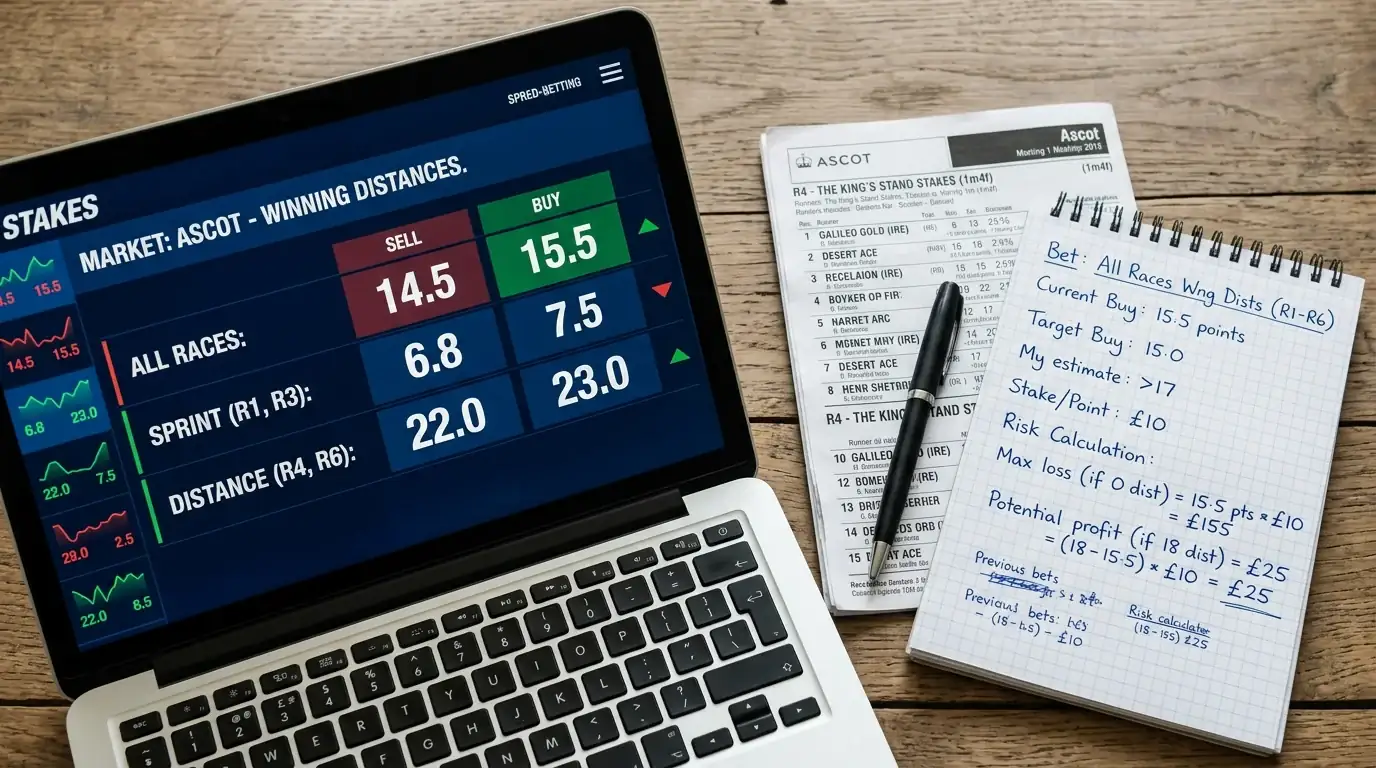
Winning distance bets ask you to predict the margin of victory — under one length, one to three lengths, over three lengths. Winning jockey and winning trainer markets are available on feature races, especially at festivals where the same names dominate. These are inherently low-liquidity markets, which means the odds can be slower to adjust and occasionally present genuine overlays for punters who track trainer form by course or jockey booking patterns.
Rule 4 and Non-Runners — What Happens When a Horse Drops Out
You have backed a 10/1 shot in a seven-runner race. Twenty minutes before the off, the 2/1 favourite is withdrawn. Your horse’s chances just improved dramatically — but so did everyone else’s. Tattersalls Rule 4 exists to adjust for exactly this situation, and it will reduce your payout.
Rule 4 deductions are applied to all bets placed before a non-runner is declared, and the scale depends on the SP of the withdrawn horse at the time of withdrawal. If the non-runner was priced at 1/1, the deduction is 45p in the pound. At 6/4, it drops to 35p. At 5/1, it is 15p. At 14/1 or longer, no deduction applies. The principle is straightforward: the shorter the price of the withdrawn horse, the more the remaining market is distorted by its removal, and the larger the haircut on your winnings.
On each-way bets, Rule 4 deductions apply separately to the win and place portions. If two horses are withdrawn, the deductions compound. In extreme cases — three or four non-runners from a small field — the cumulative deduction can eat the majority of your profit.
Non-Runner No Bet is a promotional concession offered by many bookmakers on selected races, particularly ante-post markets. Under NRNB terms, if your horse is withdrawn before the race, your stake is returned in full rather than lost. This is particularly valuable in ante-post betting, where withdrawals are common and the standard rule is that your stake is forfeit if the horse does not run.
The practical lesson is simple: know the Rule 4 scale before you bet, and factor potential deductions into your expected return. A 10/1 winner with a 25p deduction pays 7.5/1 effectively. If your value assessment was marginal at 10/1, it no longer exists at 7.5/1.
Matching the Bet Type to the Race
Richard Wayman, the BHA’s Director of Racing, noted that total betting turnover has dropped 9% year on year while the sport wrestles with broader questions about its appeal as a betting product. One of those questions, rarely asked, is whether punters are using the right tools for the job. The bet types covered in this guide are not a menu to sample at random — each one answers a specific situation.
Win singles suit strong opinions in small to medium fields. Each-way works when the odds justify the insurance premium and the place terms are favourable. Forecasts reward deep form knowledge in fields of six to ten. Accumulators and Lucky bets are recreational formats that should be sized accordingly — entertainment stakes, not bankroll commitments. Tote pools offer an alternative pricing mechanism that occasionally outperforms fixed odds. Specials and without bets exploit angles the outright market does not price efficiently.
The connecting thread is intention. Every bet you place should start with a question — what do I know about this race that the market has not fully priced? — and the bet type should follow from the answer, not the other way around. If you build that habit, the maths will look after itself.
How do fractional and decimal odds work in horse racing bets?
Fractional odds show profit relative to stake: 5/1 means £5 profit for every £1 staked. Decimal odds include the stake in the total return: 6.0 means £6 total return on a £1 bet (£5 profit plus £1 stake). To convert fractional to decimal, divide the first number by the second and add 1. Both formats express the same probability — 5/1 and 6.0 both imply roughly a 16.7% chance — but decimal notation is easier for calculating combined returns on multiples.
What is the difference between a forecast and a tricast in horse racing?
A forecast requires you to name the first two finishers in exact order. A tricast requires the first three in exact order. Both are settled at a dividend calculated after the race via the Computer Straight Forecast or Computer Tricast formula, based on the Starting Prices of the placed horses. Reverse forecasts cover both possible finishing orders of two selections and cost twice the unit stake. Tricasts are available in races with eight or more runners.
When does Tote betting offer better returns than fixed-odds?
Tote dividends tend to exceed SP on outsiders in large fields, where few pool tickets back the winner and the fixed-odds market is thinly traded. On favourites, the Tote dividend usually falls below SP because the pool is heavily weighted toward popular selections. Placepot and Jackpot pools can produce substantial returns when the results are unpredictable and winning tickets are scarce.
How is a Lucky 15 bonus calculated when only one selection wins?
Most bookmakers pay treble odds on the single if only one of your four Lucky 15 selections wins. If your sole winner was priced at 6/1, the single pays at 18/1 instead. On a £1 Lucky 15 (£15 total stake), that returns £19 profit plus the £1 stake — £20 total. Some operators also offer a consolation bonus if none of the four selections win, typically refunding a percentage of the total stake. Terms vary between bookmakers.
Created by the ”Best Betting Horse Racing” editorial team.