
Horse Racing Tipsters UK — How to Audit Their Records
 Available in US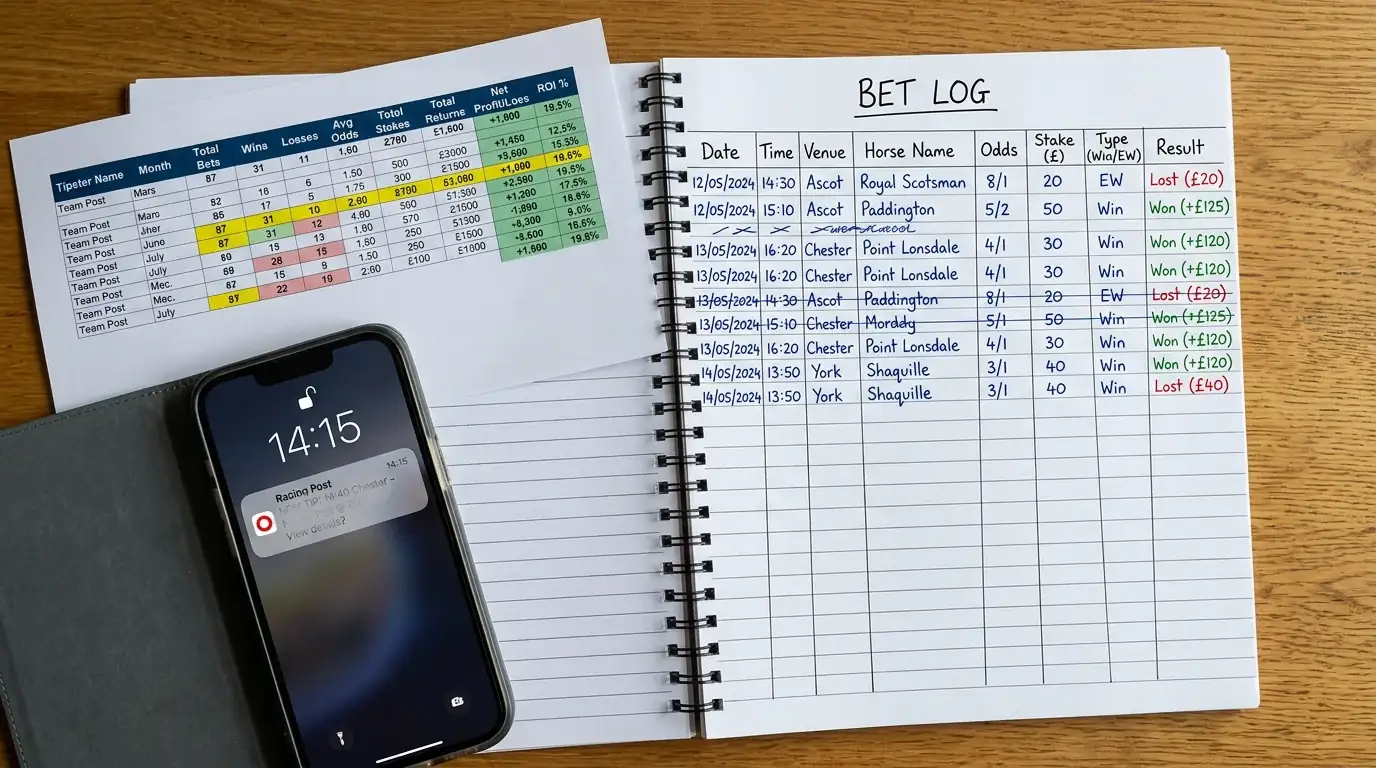
Table of Contents
The “60% strike rate” that means nothing
A reader sent me a screenshot last Cheltenham. It showed a tipster’s Twitter post claiming a 67 per cent strike rate over the previous month, with the implication that you should subscribe immediately because nobody else could find winners like this. The screenshot did not show how many bets, what the average price was, what the staking plan was, or whether the strike rate was calculated on advised prices or actual taken prices. The reader wanted to know whether 67 per cent was good. The honest answer was that 67 per cent was a meaningless number on the information he had been shown. It could mean the tipster was extraordinary. It could equally mean they were tipping nothing but odds-on favourites in low-grade selling stakes. Without the surrounding data, the headline strike rate told you nothing about whether subscribing would make you money.
The UK racing tipster industry runs through a complicated mix of free Twitter accounts, paid Substacks, members-only forums, proofing services that audit results independently, and the major racing-press tipping columns. Millions of pounds change hands each year in subscription fees. Gambling Commission data shows online racing turnover has fallen by around £1.6bn since 2022 — and the parallel pressure on tipster subscription revenue has driven some operators to inflate their records in increasingly creative ways. This guide is about the audit frame that separates real proof from marketing copy.
You may also find Horse Racing Welcome Offers UK — How to Read Sign-Up Bonuses Without Getting Trapped interesting.
The red flags that appear in nine out of ten dodgy records
Most poor tipster records share a recognisable set of features. Once you have seen them once you tend to spot them inside a minute on any new service.
Selective posting. The tipster posts winners regularly and is conspicuously quiet about losers. The Twitter feed is a highlight reel rather than a complete log. The test: count the posted tips for a defined week and check against the actual race results to see whether every losing tip from that week is also visible. Most selective posters have substantial gaps.
Retroactive stake adjustment. The bet log shows stakes scaled retrospectively — small stakes on losers, larger stakes on winners. The result is a profit log that looks far better than the strike rate would suggest. Genuine staking plans are declared in advance and applied consistently. Watch for tipsters whose “advised stake” varies wildly without an articulable rule.
Missing or fuzzy timestamps. Tips published without a timestamp before the race make it impossible to know what price was available when the tip went out. Tipsters who advise after the off, or who edit their tips post-result, are not auditable in any meaningful sense. A genuine tip carries the time of advice, the price advised, the operator the price was available at, and the race details.
ROI without bet count. “ROI 30 per cent this month” tells you nothing without the bet count behind it. Three winners from six bets is a 30 per cent ROI that means almost nothing statistically. Three hundred winners from a thousand bets is a 30 per cent ROI that would be extraordinary. The bet count is the entire context for any ROI claim. The Big Punting Survey work consistently shows that bet counts of 50 to 100 are below the noise threshold for any reliable ROI assertion.
Headline strike rate without price context. “60 per cent winners” sounds impressive until you find out they are all priced at 1/3 or shorter. Strike rate without average price is half the picture. A 60 per cent strike rate at 4/6 is a slowly losing strategy. A 25 per cent strike rate at 7/2 is a profitable one. The combination is what matters.
Implausible win sequences. Strike rates of 80 per cent or more over substantial samples are extraordinarily rare in racing. Treat such claims as marketing rather than data. Genuinely audited tipsters typically run long-term ROI of 5-15 per cent at strike rates of 25-35 per cent on bets at moderate prices — that is the territory of a genuinely good tipster.
What real proofing actually looks like
The defining feature of a tipster worth paying for is independent proofing. The tipster’s record is verified by a third party who has no commercial relationship with the tipster’s profit and loss. Several proofing services operate in the UK, each with different methodologies.
Smart Betting Club. A long-running subscription service that monitors a stable of tipsters and produces reports on their performance. SBC reviews include sample sizes, audited ROI, strike rates by category, and longitudinal performance going back years in some cases. Tipsters covered by SBC have agreed to time-stamped tip publication and full disclosure of losing bets alongside winners. The SBC reviews are paywalled, but the methodology is transparent, and the absence of a tipster from SBC coverage is a signal in itself — most tipsters worth paying for have been reviewed somewhere in the SBC archive.
Bet Stamp. An independent timestamping service. The tipster posts the tip to Bet Stamp at the time of advice, the Bet Stamp system records the time and content of the tip cryptographically, and the result is verifiable by anyone. Bet Stamp does not assess quality — it just verifies that the tip was published before the race and at the claimed price. The verification layer is the foundation other audits build on.
Time-stamped publication on the tipster’s own platform. The minimum acceptable standard. The tip is posted with a public timestamp before the race. The bet log is published in full with every tip, win or lose, traceable to a specific race and specific price. The tipster does not edit or delete tips after the result. The bet log goes back at least 12 months and ideally several years.
Full bet log access. The tipster publishes every single tip — the wins, the losses, the void bets, the late strikes, the cancelled selections. The log is downloadable as a spreadsheet, sortable, filterable, and auditable. The transparency is the point. A tipster who will not publish a full bet log is a tipster you cannot evaluate. They might be excellent. You just have no way of knowing.
Customer-side audits. Subscribers can track tips in their own bet log and compare against the tipster’s published record. Some services generate independent customer-side records automatically — any divergence between the tipster’s claim and the subscriber’s actual experience is immediately visible.
Sample size and what your spreadsheet can actually claim
The single biggest mistake punters make when assessing tipsters is treating short-term results as evidence. The variance in racing tips at moderate prices is enormous, and the sample size you need before you can confidently say a tipster has a positive edge is much larger than most people realise.
The maths. To assert with reasonable confidence that a tipster has a true ROI edge of 5 per cent or more, you typically need 500 to 1,000 bets at average prices of 3/1 to 5/1. At longer average prices, the sample size needs to be larger because the variance is wider. At shorter average prices (odds-on favourites), the sample size can be smaller but the absolute edge per bet is also smaller, so the cumulative profit is modest.
Confidence intervals in plain English. A tipster showing 12 per cent ROI over 200 bets has a confidence interval that includes both “5 per cent ROI” (very good) and “20 per cent ROI” (extraordinary), plus the possibility that the 12 per cent is noise around an underlying flat or slightly negative true edge. Two hundred bets is not enough data to distinguish those cases. Over a thousand bets, the same 12 per cent ROI becomes a much more reliable signal — the confidence interval narrows substantially.
The corollary for subscribers. Subscribing to a tipster on the basis of three months of results is roughly equivalent to backing a horse because it won its last race. Both are weak evidence, dressed up as strong evidence by the small-sample bias that affects all of us. The tipsters worth paying for are the ones whose records cover years rather than months, and whose audited samples run into the thousands of bets rather than the hundreds.
The Big Punting Survey work consistently identifies sample-size confusion as the single biggest reason punters subscribe to tipsters who do not deliver. The defence is patience — refuse to subscribe on three months of results, demand the full multi-year record, and ignore the headline figures in favour of the bet log.
Learn more about best betting horse racing on our main page.
Paid versus free — when the maths works either way
The decision between a paid tipster and a free service comes down to a simple expected-value calculation that most subscribers never run.
The framework. A paid tipster’s effective ROI to you is their advised ROI minus the subscription cost divided by your turnover. If the tipster charges £40 a month and you turnover £400 a month following their tips, the subscription is taking 10 per cent of your turnover. To break even net of subscription, the tipster needs a 10 per cent ROI before subscription costs. To be worth paying for over a free alternative, they need to be meaningfully better than free.
The maths against most paid tipsters. The free racing-press tipping (Racing Post, Sporting Life, ITV pundits) operates at roughly flat to slightly negative ROI over long samples — the tipsters are competent but the prices they tip are well-known and have been bid down by the time the tip is published. Most paid tipsters operate at similar effective net ROI after subscription costs because the subscription bridges the gap between their underlying edge and breakeven. The exceptions — paid tipsters who genuinely deliver positive ROI net of subscription — are rare, and they tend to be the ones covered favourably by SBC over multi-year periods.
Subscription cost relative to turnover matters. A tipster charging £40 a month is only realistic if you are turning over enough volume that the £40 is a small fraction of your annual stake. If you stake £20 a week following their tips, the £40 a month subscription is eating a third of your turnover and no realistic edge can compensate. The subscription pricing is designed for serious-volume punters, and casual punters are usually better off with free services and their own form work.
When paid wins. When the tipster’s audited multi-year record shows ROI in the 8-15 per cent range over thousands of bets, when your turnover at the recommended staking plan is high enough that the subscription is a small fraction of staked volume, and when you can follow their tips at the advised prices reliably (BOG-eligible, no account restrictions). All three conditions need to hold for the maths to work.
The audit checklist for any new tipster service
The discipline. Before subscribing, run the same set of checks. How many years does the published bet log cover? How many bets in total? What is the audited ROI, by whom, and over what sample? What is the average advised price? What is the staking plan, and is it consistent across the log? Are the tips time-stamped, with prices verifiable against operator screenshots from the time? Is every losing bet present in the log alongside the winners? What is the subscription cost relative to your expected turnover at their recommended stakes? Run the checks before paying anything, and treat the absence of clean answers as a decisive no. The discipline that protects you most of all is the willingness to walk away from a tipster whose marketing is louder than their record. The clean services know this and welcome the scrutiny. The rest are the ones doing the heavy lifting in the £1.6bn turnover decline. For more on how tipster work sits inside broader value-betting and bankroll discipline, the UK horse racing betting strategies guide covers the wider framework.
How can I verify a tipster’s claimed ROI is to advised prices?
Pick a sample of 20 to 30 historic tips from the public log and cross-reference each one with the price that was actually available at the time of the tip. Operator price-history tools, Racing Post archives, and Bet Stamp records can reconstruct the prices. If the tipster’s claimed ROI matches the prices a regular punter could have taken at the time of advice, the claim is sound. If the claimed prices are systematically better than what was available, the ROI is inflated.
Should I subscribe to multiple tipsters or just one?
Subscribing to multiple tipsters increases your exposure to subscription costs and your bet volume, but does not necessarily improve your edge — the tipsters’ selections often overlap on obvious horses. A more efficient approach is to subscribe to one tipster whose record you have audited, follow their advice consistently, and add free alternative services for cross-reference rather than additional subscriptions. Multiple paid subscriptions only make sense for high-volume punters where the subscription cost is small relative to turnover.
Created by the ”Best Betting Horse Racing” editorial team.