Responsible Gambling Tools UK — GAMSTOP, Limits and Reality Checks
 Available in US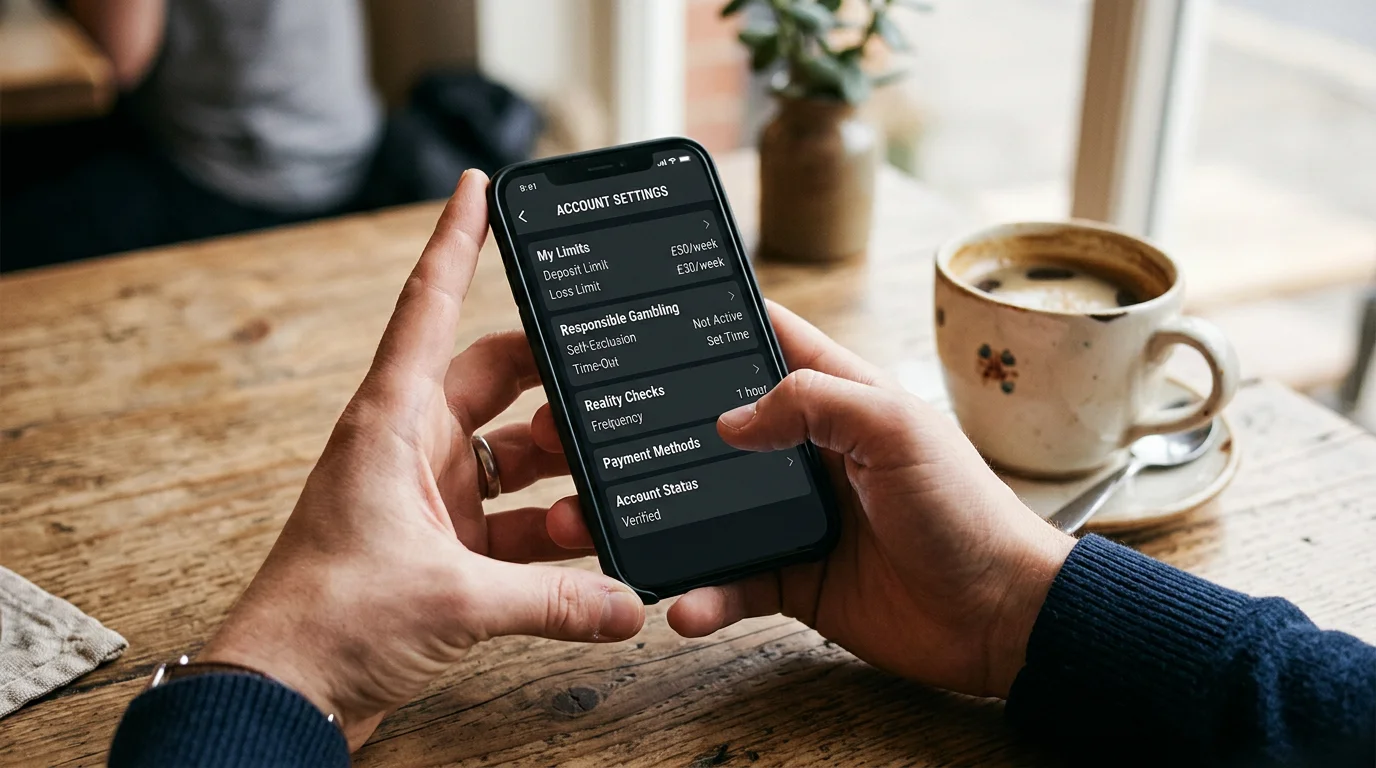
Table of Contents
The toolkit that lives inside every UKGC account
The single most useful conversation I have had with another punter in the past year was with a friend who had just adjusted his deposit limit at one of the major operators. He had not done it for any dramatic reason — he was simply running a smaller racing budget than the previous year and wanted the spending cap to reflect that. He told me he was surprised how easy the tool was to use. He logged in, set a monthly limit, and it took effect immediately. No customer service phone call, no documentation, no friction at all. The friction comes only when you try to raise a limit — which is precisely the right place for the friction to sit.
Every UKGC-licensed operator runs a defined set of responsible-gambling tools inside the customer account. The tools include self-exclusion through GAMSTOP, deposit limits, loss limits, time-out periods, reality check pop-ups, and direct links to support resources. The tools have been part of the licensing framework for years, but the operator implementations have improved steadily, and the 2024 Gambling Survey for Great Britain found 10.3 per cent of UK adults bet on sports and racing online — a substantial customer base for whom the tools are part of the standard product experience. The Gambling Commission pilot data on affordability checks shows around 95 per cent of light-touch checks resolve without play interruption, demonstrating that the regulatory framework operates at scale without major customer friction in the vast majority of cases.
This piece walks through GAMSTOP, the deposit and loss limit mechanics, the time-out and reality check tools, and the practical support resources that sit alongside the operator-side tools.
You may also find Royal Ascot Betting UK — Five-Day Festival Markets and Each-Way Value interesting.
GAMSTOP — what it does and what it does not
GAMSTOP is the national multi-operator self-exclusion scheme for UK-licensed gambling operators. The scheme is integrated into every UKGC licence and customers can register for self-exclusion through a single online registration that applies across all licensed operators.
The mechanic. A customer registers at GAMSTOP, selects a self-exclusion period (6 months, 1 year, or 5 years), and the registration is propagated to every UKGC-licensed operator within hours. The customer’s account at every licensed operator is suspended for the duration of the exclusion. New account registration with any licensed operator is blocked — the operator’s KYC system checks GAMSTOP at registration and refuses the application if the customer is currently excluded.
The scope. GAMSTOP covers all UKGC-licensed online gambling — sports betting, casino, bingo, poker. It also covers UK-licensed remote operators offering pool betting. The coverage is comprehensive across the licensed UK market.
The boundary. GAMSTOP does not cover non-UK-licensed operators. Unlicensed offshore sites operating outside the UKGC framework are by definition outside GAMSTOP. This is one of the most significant boundary issues in the responsible-gambling architecture — customers who self-exclude through GAMSTOP can still access unlicensed sites, which is part of what drives the policy concern about the unlicensed market growth.
The reversal mechanics. GAMSTOP self-exclusion cannot be undone before the chosen period expires. The 6-month, 1-year and 5-year options are firm commitments. At the end of the period, the customer must actively choose to re-enable their account — the exclusion does not auto-lapse without an active opt-in. The structural design is deliberate: the friction is on coming back to gambling, not on stopping.
The complementary tools. GAMSTOP is the heaviest self-protection tool. Operator-level tools — single-operator exclusion at one specific brand, deposit limits, loss limits — sit alongside as lighter alternatives. A customer who wants to step back from a single operator without national exclusion uses the operator-level tool. A customer who wants nationwide protection uses GAMSTOP. The 2024 UKGC Gambling Survey for Great Britain found just over ten per cent of UK adults bet on sports and racing online, and within that customer base the proportion using GAMSTOP has grown steadily as awareness has spread. For more on how affordability checks intersect with self-exclusion choices, the affordability checks explained UK guide covers the regulatory framework that contains both tools.
Deposit and loss limits — the daily, weekly, monthly cap
Deposit limits and loss limits are the most widely used responsible-gambling tools at UK operators. They allow customers to cap the amount they can deposit or lose in defined periods.
Deposit limit mechanics. The customer sets a maximum amount they can deposit across a defined period — daily, weekly, or monthly. The operator’s system enforces the cap automatically. Any deposit attempt above the cap is rejected at the point of deposit. The customer cannot exceed the limit even if their account balance permits it.
Loss limit mechanics. A different mechanism — the customer sets a maximum net loss they can sustain across the period. Once the loss reaches the cap, the operator suspends further betting for the remainder of the period. The mechanic captures the actual harm-relevant variable (net losses) rather than the gross deposit flow that may include redeposited winnings.
The asymmetric mechanic. The key structural feature of both tools is the asymmetry between reducing and raising limits. A reduction takes effect immediately — the customer can lower a deposit limit from £500 monthly to £100 monthly in a single click, and the new lower limit applies from that moment. A raise requires a cooling-off period — typically 24 hours, sometimes 7 days at certain operators — between the request and the new higher limit taking effect. During the cooling-off period, the customer can cancel the raise and the limit stays at the lower level.
The intent behind the asymmetry. Reductions are an act of self-protection and should not be impeded. Raises are decisions that could be made impulsively in the middle of a frustrating session — the cooling-off period gives the customer time to reconsider before the higher limit applies. The design is well-evidenced in behavioural research and has been part of the regulatory framework for several years.
The defaults. Most operators set default deposit limits at modest levels for new accounts — commonly £100 or £200 per day, with the customer needing to raise these limits to bet at higher levels. The default-low approach has been part of the licensing framework reforms over the past few years and has reduced impulsive high-stakes patterns at the early stage of customer journeys.
Loss limit nuances. Loss limits work better as a self-protection mechanic than deposit limits because they capture the actual harm exposure. A customer with a £200 weekly deposit limit who deposits, wins, withdraws, and redeposits can run substantially higher net activity than a customer with a £200 weekly loss limit. Loss limits are less commonly used than deposit limits despite the cleaner mechanic, partly because the concept is harder to communicate to new customers.
Learn more about best betting horse racing on our main page.
Time-outs and reality checks — the lighter touch tools
Below the heavier self-exclusion and limit tools sit a set of lighter-touch features designed to introduce friction into the playing experience.
Time-out periods. A short-duration suspension of account access. The customer chooses a period — typically 24 hours, 7 days, 30 days — during which the account is locked. The time-out is reversible at the end of the chosen period without active intervention from the customer, in contrast to GAMSTOP which requires an active opt-in to return. Time-outs are designed for customers who want a short break without committing to longer-term exclusion.
The difference from self-exclusion. Time-outs are operator-specific rather than industry-wide. A time-out at one operator does not affect the customer’s accounts at other operators. Self-exclusion through GAMSTOP is industry-wide. The two tools serve different needs — time-outs for occasional resets, self-exclusion for systematic stepping back.
Reality check pop-ups. Mandatory pop-up notifications at defined intervals during a betting session. The pop-up shows session duration, net loss or win during the session, and a prompt to consider whether to continue. The pop-ups have been part of the UKGC framework for several years and were strengthened in 2025 with required minimum frequency standards and clearer wording.
The 2025 UKGC standards. The Commission’s requirements specify that reality check pop-ups must appear at intervals not exceeding one hour during any betting session, must clearly display session time and net financial position, and must require an active acknowledgement (a click) from the customer before the session can continue. Operators with non-compliant reality check implementations have faced regulatory action.
The effectiveness. The behavioural research on reality checks is mixed. Some studies find meaningful reductions in session length and bet frequency after pop-ups appear; others find that customers click through the pop-ups without genuinely considering the prompt. The current UKGC framework reflects an intermediate position — pop-ups are required, but their efficacy depends on individual customer engagement. The Gambling Commission’s pilot data shows about 97 per cent of enhanced affordability checks resolve without prolonged account interruption, which is the broader pattern of how the modern responsible-gambling architecture operates at scale: most customers engage briefly with a tool and continue activity, with the tools serving as friction-points rather than barriers.
Where to get help — the support resources
The toolkit inside the operator account is the first layer of protection. The support resources outside the operator account are the second layer, available for customers who want help beyond what self-management can provide.
GamCare. A confidential support service that operates a 24/7 helpline and online chat. GamCare provides information, support and onward referral to treatment services for anyone affected by gambling. The service is funded primarily through industry contributions but operates independently. The helpline is the most-used phone-based resource for UK gambling support.
GambleAware. The UK charity providing information and resources around gambling. GambleAware runs awareness campaigns, funds research, and operates the National Gambling Helpline (delivered in partnership with GamCare). The website carries extensive information on the structure of UK gambling, the available tools, and pathways to treatment for those who need it.
National Gambling Helpline. The 24/7 phone-based service jointly operated by GamCare and GambleAware. Calls are confidential and the service does not require registration. The helpline number is published on every UKGC-licensed operator’s website and is included in mandatory operator footer information.
NHS treatment services. The NHS Gambling Service operates specialist clinics across England and provides funded treatment for gambling-related issues. Referrals can come from GPs, self-referrals through the NHS website, or referrals from GamCare and other support organisations. The service has expanded substantially over the past few years and now operates more clinics in more regions than at any previous point.
The practical positioning. The support resources are not only for crisis situations. They are general resources that anyone with questions about their own gambling activity — patterns, frequency, financial impact, time spent — can use. The conversation with GamCare or a similar resource is often the first step in considering whether self-protection tools should be used more actively, and the engagement is confidential and free.
The self-protection framework in practical use
The clean discipline. Set a default deposit limit at a level that reflects the genuine racing budget rather than the maximum the operator will accept. Review the limit periodically as circumstances change — quarterly is a reasonable cadence. Use time-outs occasionally as resets without committing to longer exclusion. Read the reality check pop-ups rather than clicking through reflexively. Know where GAMSTOP sits as the heavier tool if a more comprehensive step is appropriate. Know GamCare and GambleAware as resources for conversation and information that sits outside the operator relationship. The toolkit is comprehensive and the operators have made it genuinely accessible. The discipline that supports the tools is using them deliberately rather than treating them as boxes to be ticked at registration and forgotten thereafter.
Does GAMSTOP cover unlicensed offshore betting sites?
No. GAMSTOP is the multi-operator self-exclusion scheme for UKGC-licensed operators only. Unlicensed offshore sites operating outside the UKGC framework are not part of GAMSTOP and a self-excluded customer can technically access them. This is one of the most significant boundary issues in the UK responsible-gambling architecture and contributes to the policy concern about unlicensed market growth. The protection GAMSTOP provides is comprehensive across the regulated market and ends at the regulated market’s boundary.
Can I reduce a deposit limit without a cooling-off period?
Yes. Reductions take effect immediately at every UKGC-licensed operator. The asymmetric design — reductions instant, increases delayed by a cooling-off period — is deliberate and consistent across the regulated market. A customer who wants to lower a deposit limit can do so in seconds inside the operator account and the new lower limit applies from that moment forward.
Prepared by the Best Betting Horse Racing editorial staff.