Reading a UK Racecard — Form Strings, Distances and Going
 Available in US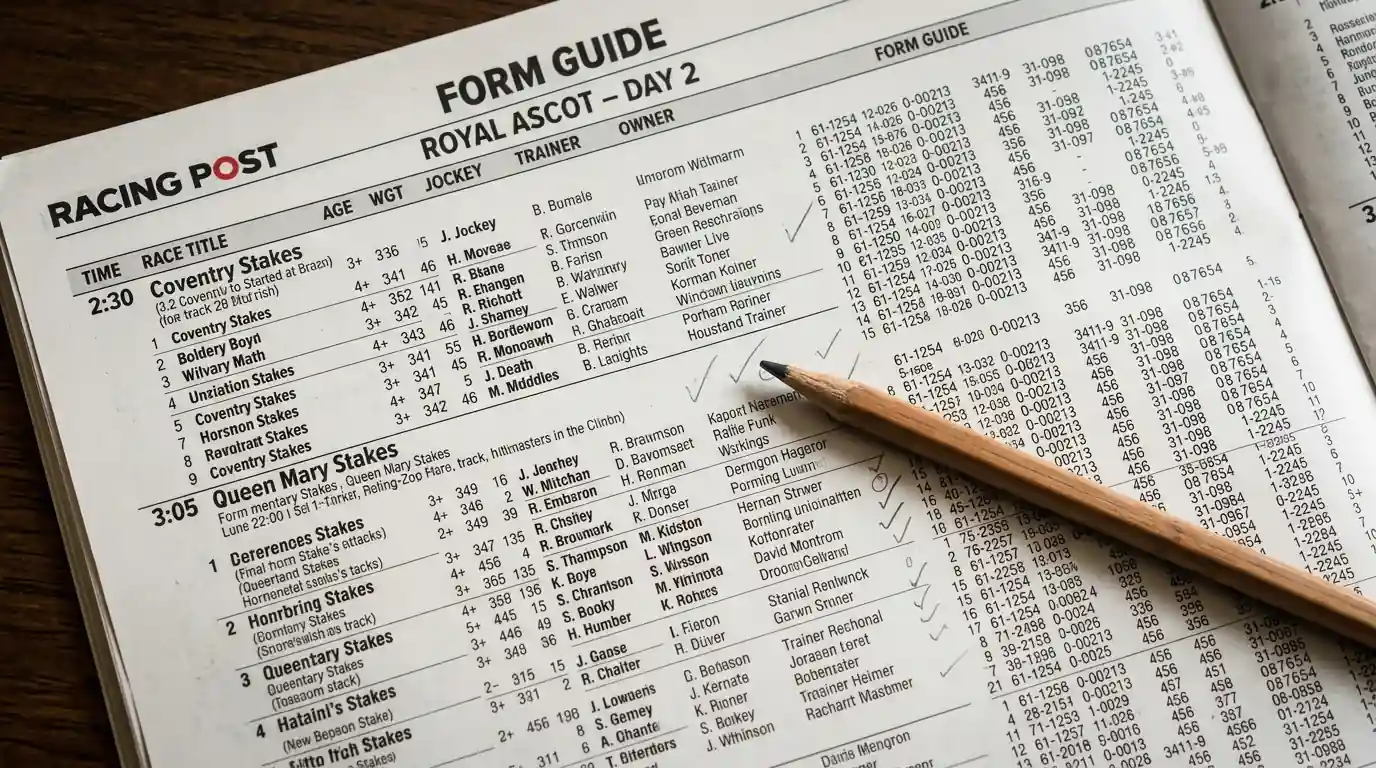
Twenty fields in sixty seconds
The first time I sat down with a fresh punter and asked her to read a Racing Post racecard, she lasted about ten seconds before asking what “1F4P0–PU/3” meant. It was a fair question. The form string alone packs six different categories of information into a handful of characters, and the rest of the racecard adds another twenty fields — distance, class, going, weight, official rating, jockey allowance, trainer last fourteen days, course-and-distance form, days since last run. The whole document is built for someone who already knows the shorthand, which is fine if you do and impossible if you do not.
Reading a racecard fluently is the single most useful technical skill in racing punting. You cannot estimate a horse’s chance of winning if you cannot decode its recent runs, the conditions of today’s race, and how the two interact. The good news is that the racecard’s shorthand is consistent across UK racing — once you have learned it once, you have learned it for every Class 7 maiden at Catterick and every Group 1 at Ascot. The Racing Post publishes most of the standardisation, and the BHA’s 2025 Racing Report data shows the timeliness of UK racing improving sharply (87.6 per cent of races started within two minutes of advertised time in Q1 2025 versus 79.2 per cent in 2024) — which means the racecard you read at 1.30 is the document being raced at 1.32.
This guide walks through the form string symbol-by-symbol, the distance and class structures, the going scale, and the weight-and-rating system that determines what the horse is carrying today.
Read our detailed review of Responsible Gambling Tools UK — GAMSTOP, Limits and Reality Checks.
Form string — decoding the symbols
The form string is the line of numbers and letters next to a horse’s name showing its last several runs, most recent on the right, oldest on the left. The structure is more information-dense than it looks.
Numbers. A number from 1 to 9 means the horse finished in that position. A 0 means it finished tenth or worse. So “13524” means a horse that finished first, third, fifth, second and fourth across its last five runs, most recent on the right.
Letters. Each letter codifies a specific way the horse failed to complete the race.
- F — fell. The horse fell during the race (jumps races only).
- P or PU — pulled up. The jockey pulled the horse up during the race because it was finished or in trouble.
- U or UR — unseated rider. The horse parted company with its jockey without falling itself, usually at a fence.
- R — refused. The horse refused to jump a fence.
- B or BD — brought down. The horse was knocked over by another faller, not its own fault.
- S or SU — slipped up or stopped suddenly.
- L — left at start. The horse failed to leave the gates.
- D — disqualified or demoted after passing the post.
The dividers. A hyphen (“–”) marks a season break — the gap between the end of one season and the start of the next, or a long break of months. A forward slash (“/”) marks a longer absence, typically a calendar year or more. So “1F4P0–PU/3” reads from left to right as: first, fell, fourth, pulled up, finished out of frame, end of season, pulled up first run back, returned after a year off, finished third. That single string encodes a horse that was once a winner, had a fall, came back with mixed form, took a season off, returned, struggled, took another year off, and is now placing in its most recent return.
The reading order matters. UK racecards show form most recent on the right — read right to left for the latest runs. Some American publications reverse the order. Race conditions vary between runs too — the form string does not tell you whether the third was over three miles or two miles, or whether the fall was at the first fence or the last. The form string is a summary. The detailed analysis lives in the form lines below, which are the run-by-run breakdowns showing date, course, distance, going, finishing position, and beaten lengths.
Distance and class — what today’s race actually is
The distance field on a UK racecard is in furlongs (eight to a mile) for races up to two miles, and in miles and furlongs for longer races. The notation runs like this:
- 5f — five furlongs (sprint distance, Flat only)
- 6f — six furlongs
- 7f — seven furlongs
- 1m — one mile (eight furlongs)
- 1m 2f — one mile two furlongs (Group race distance for many Flat middle-distance Group 1s)
- 1m 4f — one mile four furlongs (Derby distance)
- 2m — two miles (the shortest National Hunt race distance)
- 3m — three miles (Cheltenham Gold Cup distance over 3 miles 2½ furlongs)
- 4m 2½f — the Grand National distance
Class. UK racing is structured in seven classes, with Class 1 the highest and Class 7 the lowest. Class 1 includes all Group races (Group 1, Group 2, Group 3 and Listed) for Flat, and all Grade races (Grade 1, Grade 2, Grade 3) plus Listed for jumps. Classes 2 through 7 are progressively lower handicaps and conditions races.
Within Class 1, the further structure matters. Group 1 races (the Derby, the Gold Cup, the Champion Hurdle) are the highest level of competition with no weight penalties — every horse carries weight for age and sex only. Group 2 and Group 3 races have penalties for previous high-class wins. Listed races sit just below Group 3 and pay decent prize money but are less prestigious. The 1,423 high-rated Flat horses (90+ performance figure) in UK training in 2025 are mostly running in Class 1 and Class 2 races. Group race fields tend to be small (8–12 runners), favourites win more often than in handicaps, and the form lines are cleaner.
Class 4 handicaps with 8–12 runners are the volume engine of UK racing — the bread-and-butter races that fill weekday cards and drive weekly turnover. The competitive depth is higher than at the top because the handicap weights are designed to equalise the field. The going can favour different horses, the draw can be a factor, and the favourites win less often than in Group races. Class 5, 6 and 7 races extend the same logic with progressively lower-rated horses and bigger price swings.
For the broader picture of how distance and class interact with overall strategy and betting structure, the UK horse racing betting strategies guide brings the form-reading work into the wider planning framework.
Find the best options for best betting horse racing.
Going conditions — the variable that overrides form
The going is the official description of the racing surface. On turf, it ranges from firm (driest, fastest) to heavy (wettest, most demanding). The official going is set by the clerk of the course based on GoingStick readings and visual assessment, and it appears on the racecard as a single phrase.
The scale runs:
- Firm
- Good to firm
- Good
- Good to soft
- Soft
- Heavy
Irish racing adds “yielding” between good to soft and soft. The reason matters — Irish ground tends to ride softer than the equivalent UK going at the same description, so a horse rated on yielding form in Ireland may not be a soft-ground horse in the UK sense.
Why the going matters. Different horses have different action and preference. A horse with a high knee action — picking its feet up sharply over the ground — handles soft and heavy going well because the stride pushes through the give in the surface. A horse with a low, efficient action prefers firmer ground because it can roll its stride without effort. The form figures of a soft-ground specialist on firm going are usually disappointing, and vice versa. Many of the apparently inexplicable losses by short-priced favourites trace back to a going change between morning declaration and race time.
The notation “G/S” or “GS” on a racecard means good to soft. “GF” means good to firm. Old-style “firm to good” calls have largely been replaced by GoingStick numerical readings published alongside the descriptive going. A GoingStick reading of 9–10 means firm. 7–8 is good. 5–6 is soft. Below 5 is heavy. Track managers will water artificially in dry weather to soften the going, and watering can change the official call between morning and the off — the racecard going is the description at the time of publication, not necessarily what is raced on.
For deeper detail on going and how it affects different horse types, a dedicated going-conditions piece walks through the GoingStick and the type-by-type interactions.
Weight, handicap and the official rating
Every horse in a handicap race carries a weight allocated by the official handicapper, designed to equalise the field. The weight appears on the racecard as stones and pounds (e.g. “9–10” means 9 stone 10 pounds). The system is built around the official rating, abbreviated OR on the racecard.
Official Rating. The OR is a number from roughly 50 (very low-grade) to 130+ (top-class) that summarises the horse’s ability based on its performances against other rated horses. A horse with OR 80 is, in the handicapper’s view, slightly better than one with OR 70 — the gap is reflected in the weight allocation in handicaps. The 1,423 high-rated Flat horses in 2025 are those rated 90 or higher, sitting in Class 1 and Class 2 territory.
Weight conversion. One pound of weight equates roughly to a length over a standard distance — a horse carrying 10 pounds more than another should, in theory, be beaten one length per pound by an otherwise equivalent runner. The handicapper’s job is to set the weights so that an idealised result has every horse crossing the line together. In practice, the weights compress prices but do not eliminate edges — the handicapper is working from prior runs and may not have caught up with a horse’s current form.
Allowances. Apprentice and conditional jockeys (jumps) and amateur riders carry weight allowances — typically 3, 5 or 7 pounds depending on their experience — which are deducted from the weight the horse is set to carry. The allowance is genuine value when the apprentice is competent because the weight off the horse’s back is real, but you have to weigh the allowance against the jockey’s experience level for the specific race.
Top weight and bottom weight. The horse with the highest weight in a handicap is “top weight” — usually the highest-rated horse in the field. The lowest weight is “bottom weight”. Top weight wins less often than the favourite, on average, because the weight punishes ability — but top weights win more than their odds suggest in races where the handicapper has not caught up with improving form. Bottom weight has fewer pounds to carry but is usually the lowest-rated horse for a reason. The middle of the handicap, where rated and well-rated horses meet around the same weight, tends to be where value clusters.
The racecard quick-read in under a minute
The discipline I use on every race. Distance and class, first — what is the race and where does it sit? Going next — what conditions are the horses being asked to handle? Form string for each horse, right-to-left for the most recent runs, with attention to season-break dividers. Weight and OR for the handicap context. Allowances for any apprentice or conditional bookings. The form lines below the string for the detail on the most recent runs that matter. The cycle takes about 60 seconds per race once the shorthand is second nature, and it gives you a structured baseline for any form judgement that follows. The form string is just the start — but it is the start every racecard reader needs first.
How does a horse’s official rating change after a win?
The handicapper reviews the run within a few days and applies a rise to the OR based on the margin, the standard of the field beaten, and the pace of the race. Wins by clear margins typically result in rises of 6 to 10 pounds. Narrow wins in moderate fields might see rises of 3 to 5 pounds. The new rating applies from the next published handicap list, and the horse runs off the new rating in subsequent handicaps.
Does ‘good to soft’ behave more like good or soft on UK turf?
Good to soft is closer to soft than to good on most UK turf courses, particularly in winter when watering and natural moisture combine. The GoingStick reading is the cleaner indicator — a good to soft call at 6.5 rides softer than the same description at 7.5. Horses with proven soft-ground form generally handle good to soft well, while firm-ground specialists often disappoint on the same description.
Created by the ”Best Betting Horse Racing” editorial team.