Horse Racing Betting Apps UK — What to Check Before You Download
 Available in US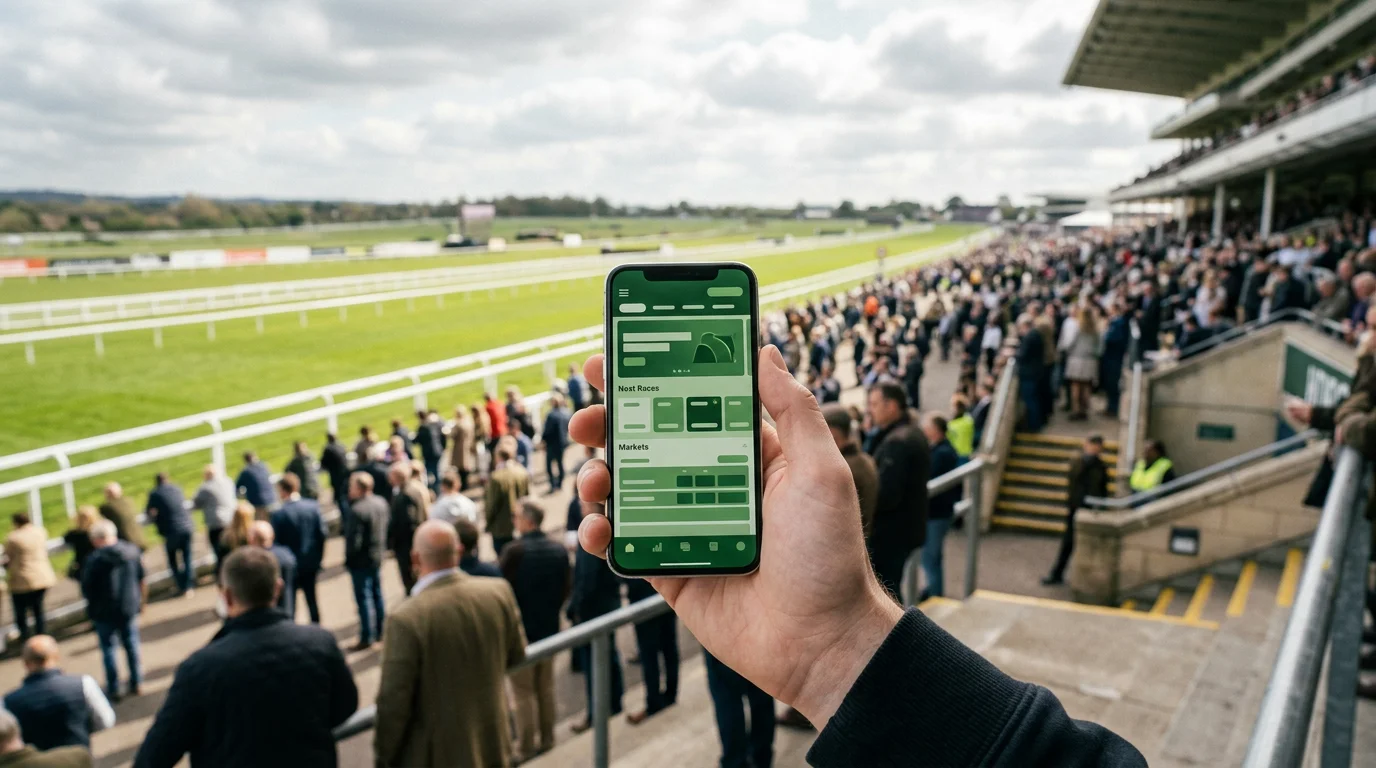
Table of Contents
- The Device That Changed How Britain Bets on Horses
- What a Racing App Must Have — The Non-Negotiable Checklist
- iOS Versus Android — Platform Differences That Matter
- In-Play on Mobile — The 60-Second Window
- Streaming Quality — What You Need to Watch Live
- Deposits and Withdrawals — Moving Money In and Out
- Safer Gambling Tools Built Into the App
- Push Notifications — Useful Alerts Versus Noise
- Testing an App Before You Commit — A Practical Framework
- Where Mobile Racing Betting Goes From Here
- Your Pre-Download Readiness Check
The Device That Changed How Britain Bets on Horses
I stood in the Cheltenham betting ring in March 2024 and watched a man place a bet on his phone while leaning against a bookmaker’s pitch. He did not even look at the boards. That image sticks with me because it captures a shift that reshaped UK racing: over 80% of bets at that festival were placed through mobile devices. The betting ring is still there, but the real market is in your pocket.
The UK has 24.4 million active online gambling accounts, and the overwhelming majority of racing bets now originate from apps, not desktops or shop counters. That migration has made the quality of a betting app as important as the quality of the odds behind it. A poor app — slow to load racecards, laggy on in-running markets, clumsy with deposits — costs you money as directly as a bad price does, because the bet you cannot place in time is the bet that does not exist.
This guide assesses what a horse racing betting app needs to do well, where the platform differences between iOS and Android create real friction, and how to evaluate an app before committing your bankroll to it. No rankings, no star ratings, no operator names in a top-ten table. Instead, a framework you can apply to any UKGC-licensed app and decide for yourself.
Read our detailed review of Horse Racing Betting Markets for Beginners UK — A First Bet Walkthrough.
What a Racing App Must Have — The Non-Negotiable Checklist
Last autumn I tested seven racing apps over a full Saturday card at Ascot. Two failed to load the racecard within the time it took me to walk from the parade ring to my seat. One froze mid-bet. The experience confirmed what I already suspected: most apps are designed around football, and racing is an afterthought bolted on top. Here are the features that separate a genuinely functional racing app from one wearing the costume.
UKGC Licence Displayed in the App
Every legitimate betting app operating in the UK must hold a licence from the UK Gambling Commission. The licence number should be visible in the app itself, usually in the footer or the “About” section. If you cannot find it, you are either using an unlicensed product or the operator is not taking compliance seriously — neither is acceptable.
In-Running Latency Under Two Seconds
Horse racing is decided in seconds. An in-running bet placed two seconds after the price moved is a bet placed at stale odds. Acceptable latency for a racing app is under two seconds between the price update on the operator’s server and the display on your screen. Anything above three seconds makes in-running betting on horses functionally unusable.
Integrated Live Streaming
An app without live streaming is asking you to bet blind. The best racing apps offer embedded streams from UK and Irish racecourses, accessible once you have a funded account or an active bet on the race. The stream should launch within the app, not redirect to a browser — the extra step creates enough delay to miss a price movement.
Full Racecard With Form
A racecard that shows only the horse’s name and current odds is not a racecard. You need recent form figures, going preferences, trainer and jockey, official rating, weight carried, and draw position for flat races. Some apps integrate third-party data feeds that provide speed figures and sectional times. The racecard is where your betting decision is made; if it lacks depth, the app is not built for serious racing punters.
Deposit and Withdraw Within the App
Being redirected to a mobile browser to complete a deposit is a design failure. Payment processing — deposits via Open Banking, Apple Pay, or debit card, and withdrawals to the same method — should be fully contained within the app. Verification document uploads should also work in-app, not through a separate portal.
Biometric Login
Touch ID, Face ID, or fingerprint login is not a luxury. It is a security baseline. An app that relies solely on a typed password for login is slower to access, less secure, and more likely to be compromised. Biometric authentication should be available and enabled by default.
iOS Versus Android — Platform Differences That Matter
A friend switched from iPhone to Android last year and was genuinely confused when he could not find his usual betting app in the Google Play Store. The reason is simple, but not obvious: Google Play and the Apple App Store have different policies on gambling apps, and those policies create different user experiences.
Apple’s App Store permits real-money gambling apps from licensed operators, and the approval process is rigorous. The upside is that any racing app you find in the App Store has passed Apple’s compliance review. The downside is that updates can take days to clear review, which means bug fixes and feature releases reach iOS users later than Android users.
Google Play also permits gambling apps in regulated markets including the UK, but the approval criteria have historically been stricter in some regards, and some operators offer their Android app as a direct APK download from the operator’s website rather than through the Play Store. Side-loading an APK bypasses Google’s review process, which introduces a security risk. If you are downloading an APK, verify the source URL matches the operator’s official domain — not a mirror, not a third-party aggregator, and not a link from a promotional email. The safest route on Android remains the Play Store where available.
Performance differences between platforms are generally marginal on flagship devices. Where the gap widens is on older or lower-spec Android handsets, where apps built with web-view wrappers rather than native code can struggle with streaming, in-running price updates, and racecard rendering. If your device is more than three years old, test the app’s performance on a live card before committing to it as your primary account.
In-Play on Mobile — The 60-Second Window
In-running betting on a horse race is not like in-play on a football match. A Premier League game gives you 90 minutes of open markets. A flat sprint at Ascot gives you roughly 60 seconds from the stalls opening to the line. A National Hunt race stretches that to three or four minutes, but the market is frequently suspended at fences and hurdles. If your app cannot execute within that window, in-running racing is not a viable option.
The critical metric is end-to-end latency: the time from tapping “place bet” to receiving confirmation. On a well-built native app with a strong mobile signal, this should be under one second. On a web-view app or a congested network — festival days at Cheltenham are notorious for mobile signal overload — it can stretch to five seconds or more. In a market that moves by the second, five seconds is an eternity.
“In-running suspended” is a status you will encounter often during jump races. When a horse falls, unseats its rider, or the field bunches at a fence, operators suspend the market to requote. The suspension can last anywhere from three to fifteen seconds, and during that time no bets are accepted. Understanding this is important because it means in-running on jumps races is not continuous — it is a series of short betting windows between suspensions. For a deeper exploration of how in-running latency, suspension and cash-out mechanics work, the dedicated guide covers the full picture.
Cash out on mobile adds another dimension. Most apps offer full cash-out (closing your bet entirely for a guaranteed return) and partial cash-out (closing a portion of the bet and letting the rest run). The cash-out price includes the operator’s margin, typically 3-5% worse than the theoretical fair price. Auto cash-out triggers — “cash out if my profit reaches £50” — are available on some apps and useful for punters who cannot watch the race live. The speed of the cash-out execution matters: a price that was available when you tapped the button may have moved by the time the server processes it, and the app should clearly indicate when your requested price is no longer available.
Streaming Quality — What You Need to Watch Live
There is nothing more frustrating than watching your horse win on a stream that froze at the second-last furlong. Streaming quality on racing apps varies enormously, and the conditions for accessing it are not always transparent.
Most UK bookmaker apps require either a funded account (minimum balance of £1 or similar) or an active bet on the race to unlock the stream. Some operators restrict streaming to customers who have placed a bet within the past 24 hours. A few offer unrestricted streaming as a premium feature. The conditions change periodically, so check before you assume access.
The streams themselves come from two primary sources: Racing TV and Sky Sports Racing, which between them cover the majority of UK and Irish fixtures. ITV races — the major Saturday cards and festival broadcasts — are free-to-air on ITV and ITV4, which means you can watch them through the ITV Hub or Freeview without needing a bookmaker stream at all. For weekday cards and evening meetings, the bookmaker stream is usually the most accessible route.
Resolution varies by operator and by network conditions. Most apps stream at 480p to 720p on mobile, which is adequate on a phone screen but poor on a tablet or cast to a television. The real issue is not resolution but delay. Bookmaker streams typically run 3-7 seconds behind the live action at the racecourse. Television broadcasts add a further 2-5 seconds. This matters for in-running betting because the person at the track sees the action before you do — and the market can move on information you have not yet received.
If you are serious about in-running betting, the ideal setup is to combine a bookmaker stream (for the visual) with a separate live odds feed or exchange price tracker (for the numbers). The stream tells you what is happening; the odds feed tells you what the market thinks is happening. The lag between the two is where experienced in-running bettors find their edge.
Deposits and Withdrawals — Moving Money In and Out
Getting money into a betting app is easy. Getting it out quickly and without friction is where the real test begins. The payment landscape for UK gambling apps changed fundamentally when the UKGC banned credit card deposits in April 2020, and the options available in 2026 reflect that shift.
Debit cards remain the most widely accepted deposit method and typically process instantly. Visa and Mastercard are universal; some operators also accept Maestro. Open Banking — a system where you authorise a payment directly from your bank account without entering card details — is growing rapidly and offers near-instant deposits with lower fraud risk. Apple Pay and Google Pay work through tokenised card transactions and are the fastest deposit methods on mobile, often completing in under five seconds.
E-wallets occupy a middle ground. Services like PayPal, Skrill and Neteller are accepted by most operators, though some welcome offers exclude deposits made via e-wallets. This exclusion is the single most common reason new customers fail to trigger their sign-up bonus — they deposit via PayPal, place the qualifying bet, and discover the offer did not activate because the payment method was ineligible.
Withdrawals are where patience is tested. The fastest operators process withdrawals within 2-4 hours to debit cards and Open Banking. The slowest take 3-5 working days. E-wallet withdrawals are typically faster than card withdrawals — often within a few hours — but the initial withdrawal on a new account will usually require identity verification. The UKGC mandates that operators verify a customer’s age and identity before allowing withdrawals, which means your first cash-out will involve uploading a photo ID and, in some cases, proof of address.
One detail worth monitoring is the withdrawal limit. Some operators impose daily or weekly withdrawal caps, particularly on winnings derived from free bets or bonus funds. If you land a £5,000 accumulator from a free bet and the operator caps withdrawals at £2,000 per day, you will be waiting three days for full access to your funds. Check the terms before the situation arises.
Find the best options for best betting horse racing.
Safer Gambling Tools Built Into the App
A friend of mine — sharp punter, profitable over three seasons — hit a rough patch in late 2023 and blew through six months of profit in eleven days. What pulled him back was not willpower. It was a deposit limit he had set three months earlier that he could not override without a 24-hour cooling-off period. He told me afterwards that without that friction, he would have kept going. That conversation changed how I evaluate apps.
Every UKGC-licensed app must provide a set of safer gambling tools, but the way they implement them varies enormously. The minimum regulatory requirements are deposit limits, loss limits, session time reminders, time-outs, and self-exclusion. Some apps bury these three menus deep in the settings. Others surface them during registration or show a persistent link on the main betting screen. The difference matters because a tool you cannot find in the moment you need it is not a tool at all.
Deposit limits should be settable on a daily, weekly, and monthly basis. The critical detail is whether decreasing a limit takes effect immediately while increasing it requires a waiting period — usually 24 hours or longer. This asymmetry is intentional and it works. Loss limits function similarly but track net losses rather than deposits. Not all apps offer both separately, and if yours only provides deposit limits, you are missing half the picture because deposits do not capture the reinvestment of winnings.
Reality checks are timed alerts that interrupt your session to tell you how long you have been active and how much you have staked. I find 60-minute intervals useful during festival meetings when it is easy to lose track of time across multiple races. Some apps let you customise the interval, others default to 60 minutes with no option to change it.
Time-outs lock you out of your account for a set period — typically 24 hours, 48 hours, seven days, or 30 days. This is different from self-exclusion, which is the nuclear option: GAMSTOP registration excludes you from every UKGC-licensed operator for a minimum of six months, with options for one year or five years. No app can override a GAMSTOP exclusion, and any operator that tries is breaching licence conditions.
Then there are affordability checks, the most contested element in 2026. The Gambling Commission’s pilot data showed that around 95% of level-one checks and 97% of level-two checks resolved without interrupting the customer’s activity. That number surprised people who expected a universal clampdown, but the reality is that frictionless checks handle the vast majority of cases. The friction comes at higher thresholds, and that is where the debate about proportionality gets heated. What matters from an app perspective is whether the operator communicates clearly what will trigger a check and what documentation might be needed. Transparency here separates responsible operators from those who treat the process as an afterthought.
10.3% of UK adults bet online on sport and racing — a substantial population. For an app to serve that audience responsibly, safer gambling tools need to be functional, accessible, and genuinely helpful, not just ticked boxes on a compliance checklist.
Push Notifications — Useful Alerts Versus Noise
I once counted the push notifications from a single betting app over a seven-day period outside of any major festival: 34. Eleven were about racing, four were genuinely useful (non-runner alerts and a BOG confirmation), and the rest were promotional noise trying to drag me into casino slots and virtual football. That ratio tells you something about how most operators treat the notification channel.
The useful categories are straightforward. Non-runner notifications save you from backing a horse that has already been withdrawn — especially valuable if you placed an ante-post bet days earlier. Best Odds Guaranteed confirmations tell you when a price has drifted in your favour and the enhanced return is locked in. Race-start alerts for specific meetings or horses you have flagged keep you from missing a market. Cash-out threshold alerts let you set a target and get notified when your bet reaches it.
The problem is that these useful alerts arrive in the same channel as the promotional ones, and the volume of the latter trains you to ignore the former. My approach is to enable notifications for a new app, run it for a week, and assess the signal-to-noise ratio. If promotional messages outnumber functional ones, I go into the app’s notification settings and disable everything except race alerts and account notifications. Most apps now offer granular control, though some bundle promotional and transactional alerts together, which is a red flag.
There is a behavioural dimension too. Promotional push notifications are designed to trigger reactive betting — a flash offer on the 3:20 at Kempton that expires in ten minutes creates urgency, not analysis. If you find yourself opening the app because of a push rather than because you planned to bet, the notifications are controlling your behaviour rather than serving it. I disable promotional pushes entirely during flat weeks when I have no strong opinions and re-enable selectively during festivals when offers like extra places on handicaps have genuine mathematical value.
The best test of an app’s notification system is whether you can configure it to tell you only what you need and nothing else. If you cannot, that tells you where the operator’s priorities sit.
Testing an App Before You Commit — A Practical Framework
Every time I try a new betting app, I run the same test. It takes about 45 minutes, costs nothing beyond a minimum deposit, and tells me more than any review site ever could. I developed this framework after wasting time with three different apps in 2022 that looked polished in screenshots but fell apart under actual race-day conditions.
The first test is load speed. Open the app, navigate to a racecard for the next available meeting, and time how long it takes from tap to fully rendered card with odds displayed. Anything over four seconds on a decent 4G connection is a problem. Do this three times and average it. Then do it during a Saturday afternoon when server load peaks. An app that performs well at 10 AM on a Tuesday but crawls at 2 PM on a Saturday is not fit for purpose.
The second test is market depth. Pick a competitive handicap — a 12-runner race at Ascot or York works well — and check what markets are available beyond win and each-way. Are forecast and tricast markets offered? Betting without the favourite? Match bets between specific horses? The number of markets on a single race is a proxy for how seriously the operator treats racing versus football or casino, which tend to get the development resources first.
Third, test the bet placement flow. Place a small win bet and time the process from selecting your horse to confirming the bet. Count the number of taps required. Some apps need three taps (select, stake, confirm), others require five or six because of upsell screens, acca prompts, or mandatory odds-change confirmations. Fewer taps means faster execution, and faster execution matters in volatile markets.
Fourth, test customer support. Send a straightforward query through the app’s live chat — something like asking about withdrawal timeframes for a specific payment method. Measure the response time and assess whether you get a scripted answer or a genuine response. Support quality correlates strongly with how an operator handles disputes, and disputes in racing — void bets, Rule 4 deductions, dead heats — are more common than people expect.
Finally, make a withdrawal. Deposit the minimum, place a small bet, and withdraw whatever remains. Time the process from request to funds in your account. This single test reveals more about the operator’s attitude toward customers than any promotional promise. If getting money out is harder than putting money in, you have your answer.
Where Mobile Racing Betting Goes From Here
I have been betting on racing through apps since 2017, and every year the interface gets smoother while the regulatory environment gets more complex. Those two trends are pulling in opposite directions, and 2026 is the year the tension becomes visible on your screen.
Open Banking is reshaping how money moves. Instead of typing card numbers or waiting for e-wallet transfers, Open Banking lets you authorise a payment directly from your bank account through the app with a single biometric confirmation. The transaction clears in seconds, the operator has instant verification of your identity and funding source, and the KYC friction that slows down traditional sign-ups shrinks considerably. Several operators have already made Open Banking their default deposit method, and within two years I expect card payments for gambling to feel as outdated as cheques.
AI-driven personalisation is the next frontier — and the most double-edged. Apps are beginning to use machine learning to customise the betting experience: surfacing markets based on your history, adjusting racecard layouts to your preferences, and predicting which meetings you are likely to bet on. Done well, this saves time. Done poorly, it becomes a behavioural nudge engine that pushes you toward higher-margin products. The question is whether regulators will draw a line between helpful personalisation and manipulative design, and so far the Gambling Commission has not provided clear guidance on where that line sits.
The affordability checks debate will shape the mobile experience more than any technological innovation. Grainne Hurst, Chief Executive of the Betting and Gaming Council, has argued that forcing punters to hand over bank statements is intrusive and will drive customers to operators outside the licensed market where no safeguards exist. Whether you agree with that position or not, the practical impact on apps is real: expect more in-app prompts for financial verification at certain spending thresholds, and expect some punters to leave licensed apps because of them. The regulatory intent is protection, but the user experience cost is friction, and how operators manage that trade-off will determine which apps retain their racing audience through 2026 and beyond.
Your Pre-Download Readiness Check
Before you install any racing app, run through this sequence: verify the UKGC licence number in the app listing, check that in-running markets are available for UK racing, confirm live streaming access for the meetings you care about, test the deposit and withdrawal cycle with the minimum amount, and configure notification settings before your first real bet. An app that fails any of these steps is not worth your time regardless of what its promotional material promises.
The mobile betting landscape in the UK is mature but uneven. Some apps treat horse racing as their core product and build accordingly. Others bolt racing onto a football-first platform and hope nobody notices the difference. The framework in this guide gives you a way to tell them apart without relying on curated review scores or promotional rankings. Test it yourself, on a real race day, with real money — even if it is just a pound. What the app does under pressure tells you everything the screenshots cannot.
Why can’t I find some horse racing apps in the iOS App Store?
Apple requires all real-money gambling apps to carry a UKGC licence and pass additional review before appearing in the UK App Store. Some smaller operators choose not to go through this process and instead offer a mobile-optimised website or a progressive web app. If an operator’s app is missing from the App Store, check their site directly — they may offer an alternative download method, though you should verify the licence before installing anything outside the official store.
What internet latency makes in-running horse racing betting unviable?
Anything above 300 milliseconds of round-trip latency introduces noticeable delay on in-running markets, and above 500 milliseconds you are effectively betting blind because prices move faster than your connection can process. A stable 4G signal typically delivers 40-80 milliseconds, which is adequate. Wi-Fi at a racecourse can be congested, so a strong mobile data signal is usually more reliable for in-play betting at the track.
Are gambling apps allowed to bypass GAMSTOP self-exclusion?
No. Every UKGC-licensed operator must participate in GAMSTOP, and no app from a licensed operator can override a self-exclusion registration. If you register with GAMSTOP, all licensed apps will block your account for the period you selected — six months, one year, or five years. Unlicensed operators are not bound by GAMSTOP, which is one of the risks of using unregulated platforms.
Why do streaming windows differ between bookmaker apps?
Live streaming rights for UK and Irish racing are negotiated separately by each operator with the racecourses and media rights holders. Some operators hold broader agreements that cover more meetings, while others may only stream specific fixtures. The requirement to have a funded account or a recent bet to access streams is an industry standard tied to the commercial agreements, not a regulatory rule.
Prepared by the Best Betting Horse Racing editorial staff.