Black Market Betting UK — Why Unlicensed Sites Are Growing
 Available in US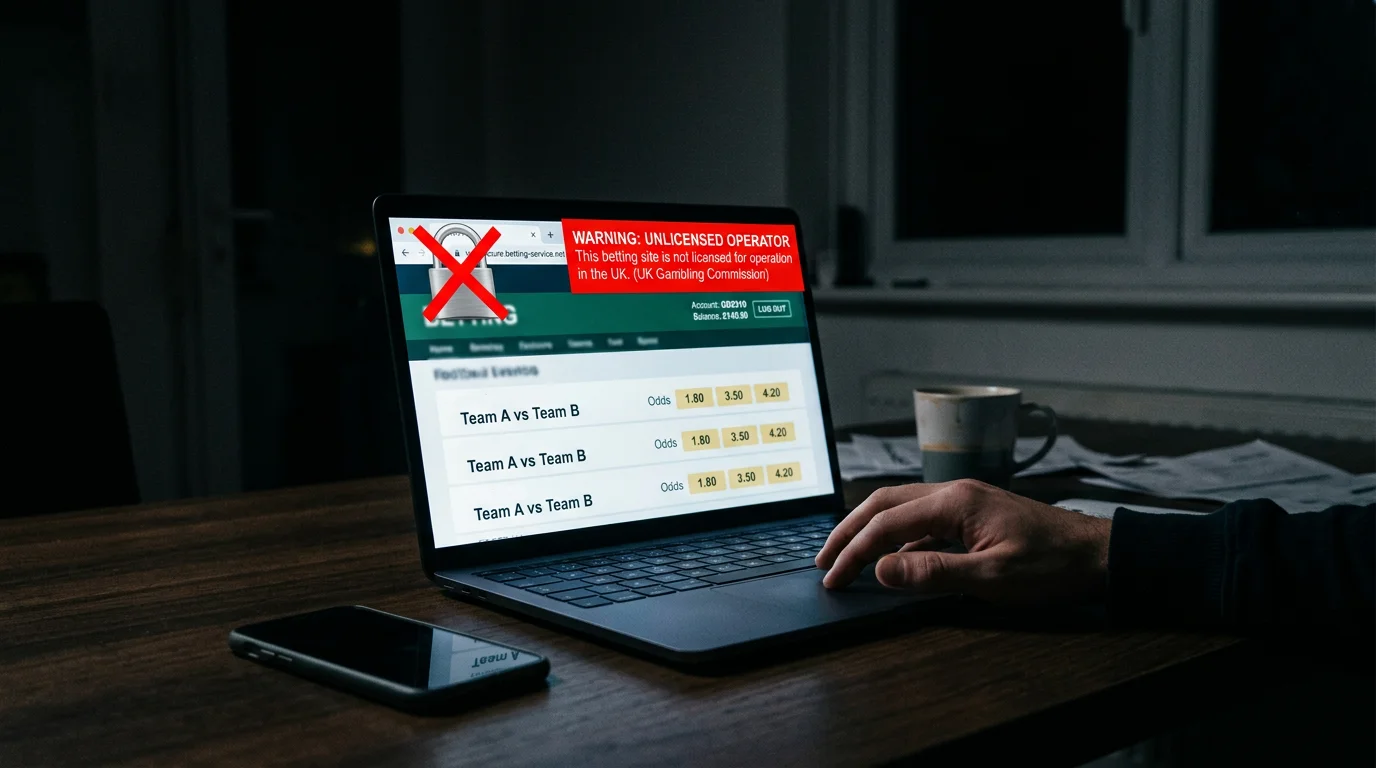
A growth chart no regulator wants to see
The single most uncomfortable statistic in UK racing regulation is the one showing unique visitors to 22 unlicensed UK-facing racing betting sites between August 2021 and September 2024. The line is not flat. It is not gently rising. It is up 522 per cent across the three-year window. Yield Sec, the analytics firm that tracks the unlicensed gambling market, estimates unlicensed operators captured 9 per cent of the UK online gambling market in the first half of 2025, generating around £379m in gross gaming yield. The Betting and Gaming Council figures put £60m in bets at unlicensed operators during the most recent Cheltenham Festival alone. None of that money goes through the regulated system. None of it contributes to the Levy. None of it is protected by the consumer safeguards that licensed operators are required to provide.
The black market is not a fringe issue. It is now a structural feature of the UK racing betting landscape, and it is growing fast enough that the BHA, the BGC, the Gambling Commission and the Treasury are all responding in different ways. This piece walks through the scale of the unlicensed market, the drivers pushing punters offshore, the specific risks unlicensed operators carry for customers, and the signals that identify an illegal site at a glance.
You may also find Cheltenham and Grand National Betting UK — Festival Markets in 2026 interesting.
The scale of the problem — numbers that have grown faster than anyone predicted
The unlicensed market grew through the early 2020s at a rate that comfortably outpaced any forecast from regulators, operators or industry observers. The headline figures tell the story.
Visitor growth. Unique visitors to 22 unlicensed sites tracked by the International Federation of Horseracing Authorities rose 522 per cent between August 2021 and September 2024. The IFHA tracked sites that specifically target UK racing punters, so the figure is a meaningful proxy for the racing-specific unlicensed market rather than the broader unlicensed gambling market.
Market share by gross gaming yield. Yield Sec’s H1 2025 estimate puts unlicensed operators at 9 per cent of the UK online gambling market by GGY, with around £379m generated in the first half of the year. That figure projects to over £750m across the full year if the growth rate held — substantial relative to the £766.7m GGY captured by the entire UK licensed online racing betting market in the financial year to March 2025.
Cheltenham Festival turnover. The BGC’s data puts £60m in bets at unlicensed operators during the most recent Cheltenham Festival. The figure is striking because Cheltenham is the biggest single event in UK racing betting and the audience is heavily made up of regular punters who would historically have used established licensed operators. The £60m at unlicensed sites represents customers who could have placed the same bets with licensed UK operators choosing not to — for reasons that are mostly traceable to specific regulatory pressures.
The Racing Post Big Punting Survey trend. The share of respondents admitting to using unlicensed bookmakers rose from 3.6 per cent in 2023 to 4.9 per cent in 2025. The increase is dramatic among higher-stakes punters — among those staking £1,000 or more per transaction, one in three reported using black-market operators. The pattern is that unlicensed market use is concentrated at the high-stakes end, where account restrictions and affordability checks at licensed operators bite hardest.
The implication. The unlicensed market is no longer marginal. It is structurally embedded in the betting habits of a meaningful share of UK racing punters, particularly the higher-stakes regulars. The growth rate has been faster than any of the regulatory responses, and the gap between the regulated market’s response and the unlicensed market’s appeal has been widening through 2024-25.
What pushes punters offshore
The drivers of unlicensed market growth are reasonably well understood and consistent across the surveys, regulatory commentary and operator reports.
Affordability checks. The single biggest driver. The share of Racing Post Big Punting Survey respondents subject to affordability checks rose from 16.6 per cent in 2023 to 23.7 per cent in 2025. Nearly one in four regular punters has now had a check. The Betting and Gaming Council CEO Grainne Hurst captured the cause-and-effect directly when she observed that forcing punters to hand over bank statements isn’t “frictionless”; it’s intrusive and will drive customers to the illegal market, where there are no safeguards at all. The 65 per cent of UK punters who say they would refuse to provide financial documents in the YouGov survey are not all moving to the black market — but the share that does move is high enough to drive the headline visitor numbers up substantially. For more on the affordability check mechanics, the affordability checks explained UK guide covers the regime in detail.
Account restrictions on winning customers. The Big Punting Survey work shows around a quarter of regular punters have had restrictions imposed on at least one account. The pattern is consistent — winning customers face stake caps, BOG removal, and ultimately account closure as the operator’s risk system identifies their profile. The customers affected are exactly the high-stakes regular punters who feature in the £1,000+ transaction band — the one-in-three share using the black market is largely composed of these account-restricted profiles.
Deposit limits and other friction. Mandatory affordability-related deposit caps, low default deposit limits on new accounts, and the cooling-off period required to raise deposit limits create friction that the unlicensed market does not impose. Customers who want to deposit substantial sums quickly — particularly during festival weeks — face delays and documentation requests at licensed operators that simply do not exist at unlicensed ones.
Higher prices and concessions. Some unlicensed operators offer materially better prices on individual races than the licensed market, particularly on overround-heavy markets like racing accumulators. The combination of better prices and concessions (no BOG limits, no extra-place restrictions, no account profile tracking) creates an apparent commercial advantage for the customer — without the regulatory protections that justify the licensed market’s existence.
The implication. The drivers are not random. They are specific regulatory or commercial decisions taken by licensed operators and regulators that have created the demand the unlicensed market is supplying. Each driver could be addressed individually — and the BGC’s policy agenda in 2026 is largely focused on reforming the affordability framework to reduce the friction that is pushing customers offshore.
The risks unlicensed operators carry — and they are real
The customer-side appeal of unlicensed operators is the absence of friction. The customer-side risk is the absence of protection. The risks are not theoretical — they are specific failure modes that have produced real customer losses across the unlicensed market.
No funds protection. Licensed UK operators are required to hold customer funds in segregated accounts. Unlicensed operators have no such obligation. Customer deposits sit in the operator’s general business accounts, available to the operator’s creditors, available to be moved or withdrawn by the operator’s principals, and not protected in any insolvency scenario. The pattern of unlicensed operators going dark — disappearing with customer funds — is well documented across the industry.
No dispute resolution. Licensed operators offer alternative dispute resolution through approved ADR providers, with decisions binding on the operator. Unlicensed operators offer no such mechanism. A dispute with an unlicensed operator has no formal resolution route — the customer’s only recourse is whatever the operator chooses to do, which is typically nothing if the dispute involves substantial sums.
KYC returning at the worst possible moment. Unlicensed operators frequently impose KYC requirements only at withdrawal — they accept deposits with minimal verification but require extensive documentation before paying winnings. The customer can deposit and lose freely but face documentation hurdles when trying to withdraw a win, and the documentation requirements at this stage can be substantially more onerous than any licensed operator imposes upfront.
No GAMSTOP integration. Customers who have self-excluded through GAMSTOP cannot register or deposit at any licensed UK operator. Unlicensed operators are outside the scheme by definition. The GAMSTOP bypass is the single most concerning feature of the unlicensed market from a customer-protection perspective — it provides an active gambling route for customers who have specifically signalled they want to be excluded. The harm potential is substantial and well documented.
Payment dispute exposure. Customers depositing to unlicensed operators with debit cards, credit cards or e-wallet payments may find their payment provider declines chargeback requests because the underlying transaction was with an unregulated entity. The protections customers expect from their payment provider may not apply, and recovery of disputed funds through payment networks is difficult.
Identity and data risk. Customers providing personal data, ID documents and bank details to unlicensed operators are sharing those credentials with entities that have no UK regulatory accountability. Whether the operator is honest or not, the data is being held outside the protective framework that licensed UK operators must comply with under data protection law. The pattern of unlicensed-operator data breaches is real and the costs to affected customers are non-trivial.
Learn more about best betting horse racing on our main page.
Spotting an unlicensed site at a glance
The signals are recognisable. The Racing Post Big Punting Survey data shows that customers who use unlicensed sites are typically aware they are doing so — the question is not whether they can identify the sites but whether they choose to use them anyway. The flag-spotting checklist matters most for customers who might accidentally end up on an unlicensed site through marketing exposure or misleading promotion.
Crypto-only or crypto-primary deposits. UK-licensed operators accept GBP through bank transfer, debit card and e-wallets. Crypto-only deposits — particularly with no GBP alternative — are a strong signal of unlicensed operation. A small number of licensed operators have begun accepting crypto under specific compliance frameworks, but the absence of any non-crypto deposit method is itself a flag.
No UKGC licence number in the homepage footer. Every UK-licensed operator publishes a licence number, typically in the homepage footer. Absence is a signal. A licence number that returns no match on the UK Gambling Commission public register is a stronger signal — it usually indicates impersonation of regulatory status.
.com or non-UK domain targeting UK customers. UK-licensed operators typically use .co.uk or established .com domains with verifiable public history. Operators targeting UK customers from unusual TLDs (.io, .net, country-code domains from offshore jurisdictions) without verified UKGC licensing are operating outside the regulated framework.
No 18+ verification or KYC at registration. UK licensing requires age verification at registration. Operators advertising “instant play” or “no verification” sign-up are advertising that they do not run UK-compliant onboarding. The marketing copy itself is the giveaway.
VPN-friendly messaging. Operators that pitch themselves as accessible “from anywhere” or “without restrictions” are typically targeting customers who have been GAMSTOP-excluded or affordability-restricted at licensed operators. The marketing is the regulatory bypass advertised in plain sight.
The black market is not a shortcut
The economic appeal of unlicensed operators is real — better prices, no friction, no documentation, no account restrictions. The cost is the entire protective layer that licensed UK operators are required to provide. Funds segregation, ADR, GAMSTOP, KYC at registration rather than at withdrawal, data protection accountability, advertising standards compliance. The licensed market trades higher friction for those protections. The unlicensed market trades the protections for lower friction. The 9 per cent unlicensed market share is the line where enough customers have made that trade to make the unlicensed market a structural feature rather than a fringe. The regulatory response is in motion — affordability framework reform, anti-illegal-market enforcement, payment-provider cooperation — but the response will take years to bring the unlicensed market share back down. In the meantime, the protective layer of UK licensing remains the default for any customer who values recourse, segregation and the consumer safeguards the regulated market is required to provide. The shortcut is real. The protections are also real. The trade-off is the customer’s to make with eyes open rather than by accident.
Are casual punters being prosecuted for using unlicensed sites?
No. UK gambling law does not criminalise the customer for using an unlicensed operator. The legal liability sits with the operator providing unlicensed gambling services to UK customers. Casual punters using unlicensed sites face the customer-side risks of funds loss, no dispute resolution and no consumer protections, but not criminal prosecution. The regulatory enforcement focuses on the operators and the payment infrastructure rather than the individual customers.
How does Yield Sec measure unlicensed market share?
Yield Sec uses a combination of web traffic analytics, payment flow analysis, and operator-side disclosures to estimate the gross gaming yield captured by unlicensed operators targeting UK customers. The methodology has limitations — unlicensed operators do not publish accounts and traffic estimates have uncertainty — but the H1 2025 figure of around £379m in unlicensed GGY is broadly consistent with the BGC’s separate £60m Cheltenham figure and the IFHA’s 522 per cent visitor growth data.
Prepared by the Best Betting Horse Racing editorial staff.