Betfair Exchange Horse Racing UK — Backing, Laying and Commission
 Available in US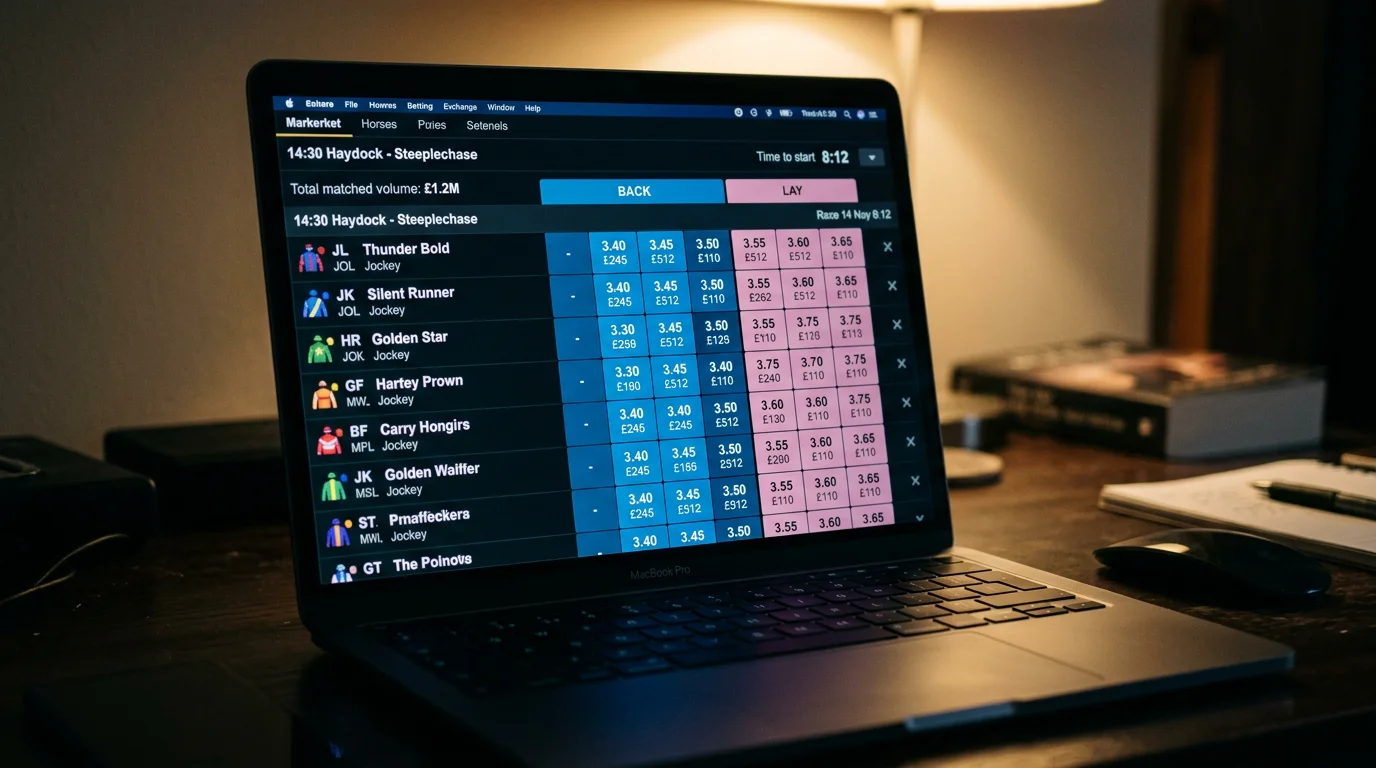
A different product entirely from your sportsbook
The first time I traded on Betfair Exchange I lost £80 in about ten minutes because I confused the “back” and “lay” buttons. Backing a horse at 6.0 felt like a normal sportsbook bet — winnings if it wins, stake lost if it loses. Laying the same horse at 6.0 was the opposite — I was offering 5/1 to someone else who wanted to back at that price, and when the horse won I owed them £500 against my £100 stake. The lay button looked identical to the back button until the bet was placed. The cost of that lesson was £80; the value of learning it before staking more was probably tenfold.
A betting exchange is fundamentally a different product from a sportsbook. There is no bookmaker setting prices. Instead, customers post prices they are willing to bet at, on both sides of the market — backing (you bet a horse to win) and laying (you bet a horse to lose). When a back offer and a lay offer match on price, a trade is created. The exchange takes a commission on winnings rather than building a margin into the prices.
UK racing turnover has fallen by 12.8 per cent over two years according to BHA figures, and within that decline the exchange market has held up better than the sportsbook market because of the structural advantages — better prices, no early-closure of winning accounts, and the ability to lay. This guide walks through how exchange prices form, the commission structure, the maths of laying, and the situations where exchange beats sportsbook and vice versa.
Read our detailed review of Black Market Betting UK — Why Unlicensed Sites Are Growing.
How exchange prices actually form
Imagine a peer-to-peer marketplace where you post “I’ll back this horse at 6.0” and someone else posts “I’ll lay this horse at 6.0”. When the prices match, you both have positions — you backing, them laying — and the trade is recorded. The exchange holds the stakes in escrow and pays out the winner. That is the entire mechanic.
The back and lay sides. At any moment in a liquid market, there are typically multiple offers on each side. The display shows the best back price (the longest odds you can currently match) and the best lay price (the shortest odds you can currently lay at). Below those headlines, there is depth — additional offers at slightly worse prices. Liquidity is the total amount of money offered at various prices. A liquid market on a fancied horse at Royal Ascot might have £100,000 backed at the best price and £100,000 laid at the best price. A thin market on a 33/1 outsider in a Class 7 evening race might have £30 on one side and nothing on the other.
The spread between back and lay. The best back price is always longer (higher decimal) than the best lay price. The gap between them is the market’s bid-ask spread. On liquid markets it is tiny — best back 6.0, best lay 5.9, a single tick apart. On thin markets it widens — best back 8.0, best lay 6.5, a meaningful gap. The spread reflects market uncertainty and liquidity.
The exchange book percentage. Sum the implied probabilities of best lay prices across all runners in the race. On Betfair Exchange, the book typically comes out at 101 to 103 per cent — essentially fair, with only the commission as the operator’s take. Sum the implied probabilities of best back prices and the book comes out at 99 to 100 per cent — you can in principle back every horse and break even before commission. The fairness of the exchange book versus the 108-115 per cent overround on sportsbook markets is the structural advantage that drives serious punters to exchanges. The £766.7m gross gaming yield on UK racing in 2024-25 captured by the Gambling Commission includes both sportsbook and exchange, but the exchange share of that volume is disproportionately large relative to the operator margin captured.
Commission — what the exchange actually takes
Commission replaces the bookmaker’s overround as the exchange’s revenue model. The structure is simple in principle and slightly more complex in practice.
The baseline. Betfair Exchange charges commission on net winnings per market, typically 5 per cent on the headline rate. If you win £100 net on a race, the commission is £5, and your net is £95. Losses are not subject to commission — they are just losses.
Volume discounts. Betfair operates a Discount Rate system that reduces commission for customers who turn over significant volume. The discount rate ranges from 0 per cent (full 5 per cent commission) down to 60 per cent (effective commission 2 per cent). The discount is based on a rolling 12-week turnover calculation, and the rate updates weekly. High-volume punters can effectively trade at 2 per cent commission versus the standard 5 per cent.
Premium Charge. Betfair operates a Premium Charge on customers who have won substantial amounts over time relative to their commission paid. The mechanic is that, once a customer has won more than the operator has earned in commission from them, an additional charge of 20 to 60 per cent on certain winnings can apply. The Premium Charge is the single most controversial aspect of the Betfair commercial model and has driven some serious winning customers to alternative exchanges like Smarkets. The detail of when the charge triggers and how it is calculated is complex and varies by customer category, but the principle is that consistently winning customers pay more than the headline 5 per cent.
Smarkets. The main UK competitor to Betfair Exchange. Charges a flat 2 per cent commission on net winnings with no Premium Charge equivalent. The liquidity is much lower than Betfair on most racing markets, but for serious winning punters the absence of Premium Charge can make Smarkets cheaper in net terms even at thinner markets. Matchbook is another UK-facing alternative, operating on similar lines.
The net cost calculation. For occasional punters with modest winnings, the headline 5 per cent commission on Betfair is roughly competitive with sportsbook overround. For serious punters with consistent winnings, the volume discount plus the Premium Charge structure makes Betfair more expensive than Smarkets on a net basis, despite the deeper liquidity.
Find the best options for best betting horse racing.
Laying — the side most punters never use
Laying is the side of the exchange that does not exist on a sportsbook, and it is the source of most exchange-specific strategies.
The mechanic. When you lay a horse, you are betting against it. You are offering odds to someone who wants to back it. If the horse loses, you keep their stake. If the horse wins, you pay out the winnings.
The liability calculation. Laying carries a different stake calculation from backing. The stake you put up is your liability — the amount you would pay out if the horse wins. The formula is liability = (lay odds − 1) × backer’s stake.
Worked example. You lay a horse at 6.0 for a backer’s stake of £10. The backer wins £10 × (6.0 − 1) = £50 if the horse wins. Your liability is £50. You put up £50 — that is the amount taken from your account to back the trade. If the horse loses, you collect the backer’s £10 stake (minus your commission on the £10 win). If the horse wins, you lose your £50.
The asymmetry matters. When you back at 6.0 for £10, your maximum loss is £10 and your maximum win is £50. When you lay at 6.0 for £10 of backer’s stake, your maximum win is £10 and your maximum loss is £50. The risk profile is reversed.
When does laying offer value? When you believe a horse’s true probability of winning is lower than the lay price suggests. A heavy favourite at 1.4 implies a 71 per cent chance of winning. If you believe the horse is closer to 60 per cent, laying at 1.4 has positive expected value (in expectation, the £10 backer’s stake you collect 40 per cent of the time outweighs the £4 liability you pay 60 per cent of the time). The catch is that the prices on heavy favourites are usually accurate — the market is very efficient on the obvious horses — and the apparent edges in laying favourites tend to be illusions on closer inspection. Where laying does work is on overhyped second favourites and on outsiders that have been bid down by sentiment money rather than form.
The corollary. Laying is a tool that requires the same value-betting discipline as backing. The probability assessment matters; the price relative to the probability is the question; the variance over time is significant. The structural advantage versus backing is that the exchange book is fair (no overround), so the laying strategies that find genuinely mispriced horses can be more profitable than equivalent backing strategies that have to overcome a 110-115 per cent sportsbook book.
Exchange versus sportsbook — when each wins
The choice between exchange and sportsbook for any given bet comes down to four factors.
Price. Exchange prices are typically 3-7 per cent better than sportsbook prices on the best back side, before commission. Net of 5 per cent commission, exchange usually still wins by 1-3 per cent on most prices, more on outsiders where the sportsbook overround is concentrated. For pure price-seeking, exchange wins.
Concessions. Sportsbooks offer Best Odds Guaranteed, extra-places promotions, refunds on selected race types, and NRNB cover on ante-post markets. None of these exist on the exchange — the exchange settles purely on the market outcome. For a regular punter, the cumulative value of BOG and extra-places on a sportsbook can outweigh the better exchange prices, particularly on UK and Irish racing during festival weeks. The price-vs-concession trade-off is the central question. For more on how concessions stack up across the year, the UK horse racing bet types guide walks through where each format sits.
Liquidity. On liquid markets — Cheltenham Festival, Royal Ascot, Saturday handicaps — exchange liquidity is deep and you can get on at the headline price for any sensible stake. On thin markets — midweek Class 7 evening races, all-weather Monday afternoons — exchange liquidity can be inadequate and you may not get the price you see, or may not get on at all. Sportsbooks always take a bet (subject to stake limits), so for thin-market punting the sportsbook is the only practical option.
Account treatment. The single most under-discussed advantage of exchanges. Sportsbooks restrict winning accounts. Exchanges do not — the exchange is happy to take your money as long as someone is willing to match the trade. For consistently winning punters who have been restricted at sportsbooks, the exchange is often the only meaningful product left.
The straightforward rule. Use the exchange for outright price advantage on liquid markets. Use the sportsbook for the concession-driven bets where BOG and extra-places stack the value. Use whichever has the better effective price for the specific bet, and be conscious of the commission and concession differences.
The exchange-trading mental model
The exchange is a market, not a bookmaker. You are not negotiating with the operator — you are matching against other customers who happen to be on the other side of the same opinion. The discipline is the same as the underlying value-betting question: are the prices on offer fair relative to your assessment of probability? The structural advantages of the exchange — fair book, no restrictions, lay capability — give you tools that the sportsbook does not, but the tools amplify whatever underlying skill you bring to the prices. The exchange does not turn a losing punter into a winning one. It does let a winning punter capture more of their edge by trading at fairer prices and on both sides of the market.
What is the difference between Premium Charge and standard commission?
Standard Betfair Exchange commission is 5 per cent on net winnings per market (reduced for high-volume customers through the Discount Rate). Premium Charge is an additional levy on customers whose cumulative net winnings substantially exceed the commission they have generated. It can add 20 to 60 per cent on certain winnings for serious winning customers. Smarkets and Matchbook do not operate equivalent charges.
Why does the lay price differ from the back price on the same selection?
The exchange operates two distinct queues of offers — back offers and lay offers — that match when prices overlap. The best back price is the longest available, the best lay price is the shortest available, and the gap between them is the bid-ask spread. The spread reflects market uncertainty and liquidity. On liquid markets it is one or two ticks; on thin markets it can be several ticks wide.
Prepared by the Best Betting Horse Racing editorial staff.