UK Budget 2025 Betting Impact — Tax Changes for Racing Punters
 Available in US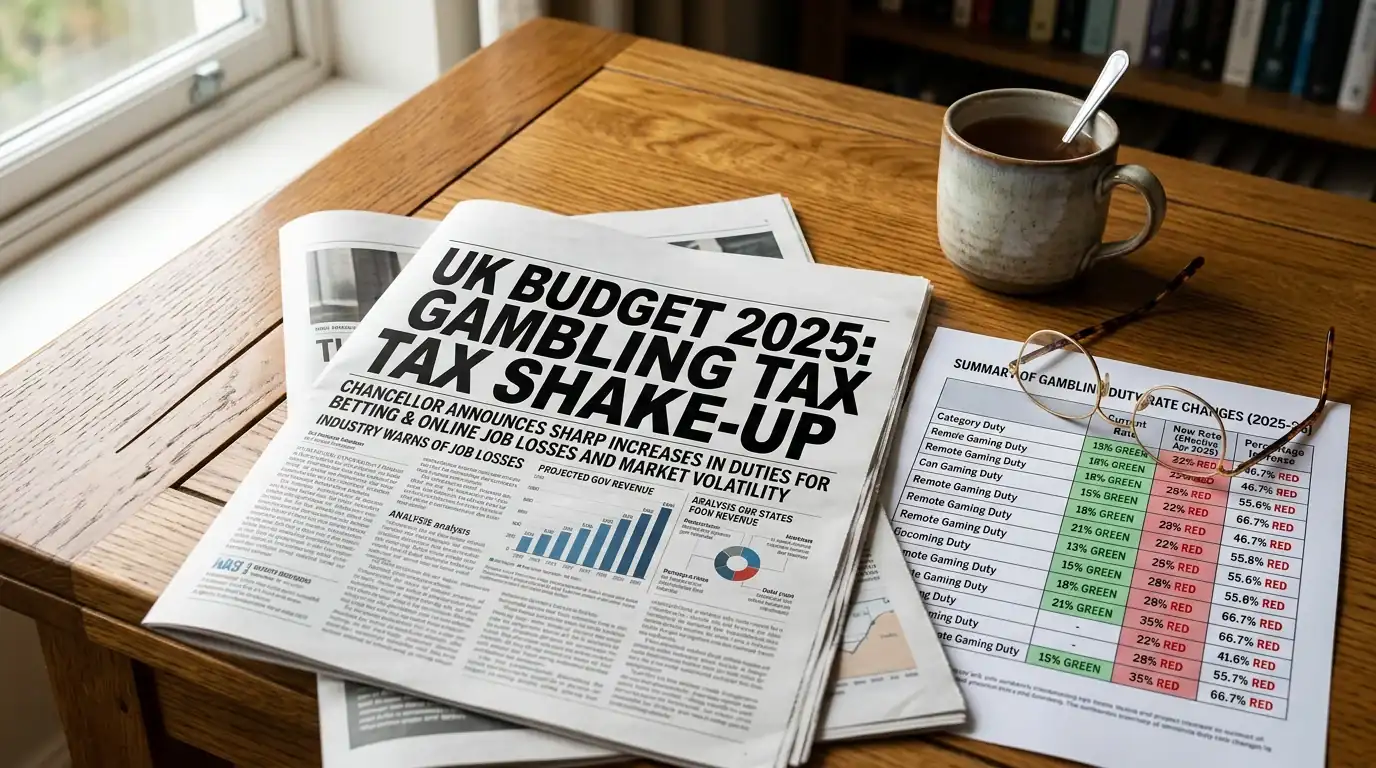
Table of Contents
- The Budget that quietly drew a line through UK racing
- What changed and when — the three-rate timeline
- Why racing was spared — the lobbying that worked
- The indirect effects — how operators will reshape concessions
- Revenue projections — what the Treasury actually expects
- What punters will notice after April 2026
The Budget that quietly drew a line through UK racing
When the Chancellor opened her Budget statement in November 2025, the gambling industry expected bad news on tax. The advance briefings had been clear that something was coming. What they did not expect was that racing — alone among gambling segments — would be spared. Rachel Reeves told the House of Commons that remote gaming is associated with the highest levels of harm and so she was increasing Remote Gaming Duty from 21 per cent to 40 per cent, while making no change to the taxes on in-person gambling or on horse racing. The single sentence created two different regulatory worlds within the same industry — one where the tax doubled overnight, one where it held steady. Racing was on the protected side of the line.
The Budget 2025 settlement is the single most important regulatory event for UK racing punters in this decade. The 15 per cent General Betting Duty rate that has applied to racing for years was preserved. Online non-racing betting (sportsbook on football, cricket, tennis, all other sports) had its GBD rate increased from 15 per cent to 25 per cent, effective April 2027. Online casino games and slots — Remote Gaming — had their RGD rate increased from 21 per cent to 40 per cent, effective April 2026. The three different rates produce three different operator economic profiles starting next April, and the effects on what punters experience on betting sites are already being signalled by operators.
This piece walks through the timeline of the three rate changes, the lobbying that protected racing, the indirect effects on racing through operator cross-subsidy, and the projected revenue impact for HM Treasury.
Check out our guide on UK Gambling Commission Licensing Explained — What Punters Should Check as well.
What changed and when — the three-rate timeline
The Budget produced three separate rate changes, each with its own effective date. The timeline matters because operators are responding to each change at the point it takes effect, not all at once.
April 2026 — Remote Gaming Duty up from 21 per cent to 40 per cent. The single largest change. RGD applies to online casino games, slots, online bingo, and online poker rake — the “remote gaming” category as defined in the Finance Act framework. Racing betting is not subject to RGD; it is subject to General Betting Duty. The April 2026 implementation gives operators about five months from Budget announcement to compliance — short by historical standards and reflecting the political urgency the Treasury attached to the change.
April 2027 — General Betting Duty up from 15 per cent to 25 per cent for online non-racing betting. The second-largest change. GBD applies to sports betting (football, cricket, tennis, other sports) and to all racing betting. The Budget split the GBD rate by product: online non-racing betting moves to 25 per cent in April 2027; online racing betting stays at 15 per cent indefinitely. Non-remote (high-street) betting on all products stays at 15 per cent. The split is operationally complex because most operators run combined sportsbook products that take bets on racing and other sports simultaneously, and the tax treatment now varies by the underlying sport.
Online racing — 15 per cent retained indefinitely. The headline win for racing. The Treasury accepted the case that racing’s economic dependence on betting (the Levy mechanism, the £108.9m record yield in 2024/25, the 85,000 jobs supported by racing) justified protecting the duty rate. The decision is not time-limited — there is no sunset clause and no scheduled review date. The rate is what it is until a future Budget changes it.
The classification question. The operational consequence is that operators have to classify every bet at the point of placement: racing or non-racing. Racing bets sit under the 15 per cent GBD rate. Non-racing bets sit under the 25 per cent GBD rate from April 2027. Online casino sits under the 40 per cent RGD rate from April 2026. Three distinct tax categories within the same operator. The classification rules are codified in the Finance Act 2025 schedule and will be enforced by HMRC with audits and compliance obligations on operators.
Why racing was spared — the lobbying that worked
The protection of racing’s tax rate was the product of an extended lobbying campaign in the months before the Budget, coordinated by the British Horseracing Authority, the National Trainers Federation, the Racecourse Association and other industry bodies. The case made to the Treasury was specific and economic rather than ideological.
The economic argument. Racing is structurally dependent on betting in a way that other gambling segments are not. The Levy mechanism takes 10 per cent of operators’ gross profits on UK racing and recycles it into prize money. The £108.9m Levy yield in 2024/25 funds the bulk of UK prize money and the training programmes that sustain the horse population. Damage the betting volume on racing, and the Levy yield falls, and the prize money falls, and the horse population declines further than the 1.9 per cent annual rate already being seen. The case landed because the numbers were verifiable and the economic logic was clean.
The Treasury’s response. Rachel Reeves in her Budget speech directly addressed the racing case, stating she was making no change to the taxes on in-person gambling or on horse racing. The exemption was deliberate and announced from the despatch box rather than buried in the Red Book. The British Horseracing Authority’s official post-Budget statement framed the outcome as recognition that betting on racing is an integral part of the enjoyment of our sport, and that maintaining the rate of horserace betting duties is an important step by the Government to help preserve revenue streams and protect the 85,000 jobs supported by the racing across the country.
The National Trainers Federation chief executive Paul Johnson welcomed the decision with notable specificity, calling the Government’s decision to leave racing’s remote betting tax rate unchanged one viewed with considerable relief, and welcoming the Treasury recognising the economic damage an increase would have inflicted on the industry. The trainers’ representation in the lobbying was particularly important because the racing economy’s most fragile link is the training population — 15,070 horses in training in 2025, down 1.9 per cent on the year.
The indirect effects — how operators will reshape concessions
The headline reading of the Budget — racing protected, other gambling taxed harder — masks an indirect effect that punters are starting to see in real time. Operators run combined products where racing and non-racing share infrastructure, marketing, customer acquisition costs and account economics. The cross-subsidy between the two segments has historically run from racing (lower-margin, lower-tax) to non-racing (higher-margin, higher-tax). The April 2026 RGD increase and the April 2027 GBD increase change the economics of that cross-subsidy.
The concession-cutting prediction. Operators have signalled in industry communications that they will need to recover margin on the higher-taxed products by reducing concession spend on the lower-taxed ones. The reasoning is straightforward — if non-racing betting becomes structurally less profitable, the operator’s incentive to support racing concessions (Best Odds Guaranteed, extra-places promotions, NRNB ante-post cover) reduces because the racing customer is no longer subsidising the non-racing customer.
The BGC reading. Betting and Gaming Council chief executive Grainne Hurst captured the dynamic with characteristic directness. Racing has seemingly been protected from higher betting duties. It sounds like a win, but anyone who understands how the sector operates knows that isn’t true. This exemption is cosmetic. Her reading is that the cross-subsidy losses from the wider tax increases will reduce the operator-side support for racing in ways that are not visible from the headline tax-rate comparison. Whether the prediction proves correct will become clear over the 2026-27 period as the rate changes take effect and operators adjust their commercial strategies.
The counter-reading. Some industry observers argue that the tax differential — racing taxed at 15 per cent while non-racing is taxed at 25 per cent or 40 per cent — will actually incentivise operators to attract more racing-specific customers because each pound of racing GGY is now structurally more profitable than each pound of non-racing GGY. Under this reading, racing concessions would intensify rather than diminish, as operators compete for the more profitable customer segment. The two readings produce opposite predictions for what punters will see in promotional terms in 2027-28.
The Levy interaction. The HBLB Levy is a 10 per cent charge on operator gross profits from UK racing, paid in addition to the 15 per cent GBD. The combined tax-plus-Levy burden on racing remains lower than the post-2027 GBD on non-racing — but the difference has narrowed slightly because the Levy framework continues to apply while GBD is held flat. The Levy yield of £108.9m in 2024/25 is funding the £77.1m HBLB allocation package for 2026, and the cross-checking on revenue is one of the structural features of the racing-betting relationship. For more on how Levy interacts with this tax framework, the horse racing Levy UK guide walks through the funding mechanism in detail.
Discover everything about best betting horse racing here.
Revenue projections — what the Treasury actually expects
The Treasury’s published revenue forecasts give a defined picture of what the changes are expected to raise.
The headline figures. The House of Commons Library estimated the gambling tax reforms collectively will raise £810m in additional revenue in 2026-27, rising to £1.16bn by 2030-31. The figures are based on the standard Treasury behavioural assumptions about elasticity of demand — how much betting and gaming activity will reduce in response to higher operator prices — and on the assumption that the RGD and GBD changes are passed through to customer pricing rather than absorbed by operator margins.
The breakdown by source. The £810m in 2026-27 is principally driven by the RGD increase from 21 per cent to 40 per cent, which applies from April 2026. The full impact of the GBD increase from 15 per cent to 25 per cent on online non-racing betting kicks in from April 2027, so the 2027-28 figure rises further as that change takes effect. By 2030-31 the £1.16bn projection assumes both changes are fully embedded and the behavioural responses have stabilised.
The behavioural assumptions matter. If customers significantly reduce gambling activity in response to higher operator prices, the revenue raised falls short of forecast. If customers maintain activity levels and absorb the price increases, the revenue is closer to or exceeds forecast. The historical record in other jurisdictions suggests behavioural responses are substantial, but the UK forecasts include assumptions that have not been fully tested.
The unlicensed market risk. The BGC’s response to the Budget framed the increases as a devastating hammer blow to tens of thousands of people working in the industry and to millions of customers who enjoy a bet. The concern is that customers responding to higher operator prices will migrate to unlicensed offshore operators rather than reduce activity, which would deliver the worst possible outcome for the Treasury (lower revenue than forecast) and for racing (lower licensed-market turnover and a smaller Levy yield). Whether this risk materialises will be visible in 2026-27 data.
What punters will notice after April 2026
The clean picture of what changes for the average UK racing punter as the rate changes phase in. Racing-specific concessions — BOG, extra-places, NRNB cover, free bets on UK racing — should hold at current levels or strengthen if the favourable-customer-segment reading is correct, and weaken if the cross-subsidy reading is correct. Both readings will be testable within 12-18 months of the April 2026 implementation. Online casino prices and bonuses will tighten substantially as the RGD increase takes effect — the casino product economy is materially less profitable from April 2026. Sports betting (non-racing) prices and concessions will tighten more gradually from April 2027 as the GBD change phases in. The 15 per cent racing GBD rate remains in place indefinitely, which is the structural reason racing is protected from the worst of the changes — but the operator behaviour around concessions is the variable that determines what punters actually experience day-to-day. Watch the BOG and extra-places markets through 2026-27 for the first hard evidence of which reading is right.
Do punters pay any direct tax on their racing winnings?
No. UK gambling winnings — including racing winnings — are not subject to income tax or capital gains tax for the recreational punter. The HMRC position is consistent across fixed-odds, exchange and spread betting products. The operator pays the betting duty, and the customer receives net winnings without separate tax. This is structurally different from many financial trading products, which can be subject to CGT depending on the customer’s overall position.
Will the 2027 GBD rise affect Best Odds Guaranteed?
The 2027 General Betting Duty rise from 15 per cent to 25 per cent applies to online non-racing betting, not to racing. BOG on UK and Irish racing is structurally protected from this specific change. The indirect risk is that operators reduce overall concession spend in response to cross-product margin pressure, which could affect BOG even where the underlying tax rate has not moved. The actual operator behaviour will become clear in 2026-27.
Written by the editors at Best Betting Horse Racing.