Horse Racing Levy UK — How Betting Funds the Sport
 Available in US
The funding mechanism nobody on TV explains properly
Every Saturday afternoon, ITV runs racing coverage that mentions prize money, runners, jockeys and trainers — and almost never mentions where the prize money actually comes from. The Levy. Most casual viewers assume the racecourse pays it, or the BHA, or maybe a sponsor. None of those answers is right in the structural sense. Roughly two-thirds of UK racing prize money is funded by a statutory levy collected from bookmaker gross profits on UK racing, redistributed through the Horserace Betting Levy Board. Last year the Levy yielded £108.9m — a record since the 2017 reforms — even though betting turnover had been falling for three consecutive years. That divergence (turnover down, Levy up) is the entire story of where UK racing’s money comes from in 2026.
The Levy is the structural connective tissue between betting and racing. Without it, the prize money model collapses, the lower-tier fixtures lose their economics, and the sport’s training population — already in decline at 15,070 horses on 31 March 2025, down 1.9 per cent on the previous year — would shrink much faster. The Levy is also one of the few things in UK racing that is genuinely unusual internationally: very few other major racing jurisdictions have an equivalent statutory framework linking betting and sport.
This piece walks through the mechanics of the Levy, where the money goes, the 2025/26 allocation, and the relationship between Levy and total prize money.
Check out our guide on Horse Racing Odds Formats — Fractional, Decimal and American Compared as well.
How the Levy actually works
The mechanic is a statutory framework, codified in law, that requires UK-licensed betting operators to contribute a percentage of their gross profits on UK horse racing to the Horserace Betting Levy Board. The Board collects, manages and redistributes the funds to racing.
The rate. The current Levy rate is 10 per cent of operators’ gross profits (winnings minus payouts) on UK horse racing. The rate applies across remote (online) and non-remote (high-street betting shop) operations. Pool betting (Tote, exchange) and certain ante-post markets are caught by separate sub-mechanisms but the headline 10 per cent applies to the bulk of operator activity.
The 2017 reform. Until 2017, the Levy framework only covered non-remote (high-street) betting operations. The 2017 reform extended the Levy to remote betting — online operations, including operators licensed in the UK from offshore corporate structures. The extension was the single biggest reform in Levy history and produced an immediate uplift in Levy yield. The record £108.9m figure in 2024/25 is roughly double what the pre-2017 framework would have generated at equivalent turnover, simply because the online betting volume that had been outside the Levy framework was now inside it.
The collection mechanism. Operators self-declare their Levy liability quarterly, with audit by HMRC and the Levy Board. The HBLB reconciles the declarations with operator licence data and turnover figures and pursues collection where declarations are incomplete. The Big Punting Survey work shows the Levy is paid by operators, not by punters directly — there is no “levy charge” on a betting slip. The cost is absorbed into the operator’s overround.
The HBLB structure. The Levy Board is a statutory body with a chair appointed by the government and a board including racing industry representatives, betting industry representatives, and independent members. The Board agrees the annual Levy scheme with industry consultation and is accountable to government. The “Levy outturn” published each summer is the Board’s account of the past year’s collection and the next year’s allocation. The current interim chair Anne Lambert was direct in her recent HBLB Annual Report on the financial pressure facing the sport, observing that racing is facing significant challenges.
Where the money goes — the three main allocations
The HBLB’s distribution of Levy funds breaks into three main categories: prize money support, integrity and operations, and capital and grant programmes.
Prize money support. The single biggest category. The HBLB tops up race prize funds across UK racing, with the top-up calibrated to the fixture grade. Premier fixtures (the highest-grade race days, typically Saturdays and major weekday meetings) receive substantial top-ups. Core fixtures (the standard weekday cards) receive smaller top-ups. The mechanism is what makes UK racing economically viable below the Class 1 level — without the HBLB top-up, the Class 6 and Class 7 weekday cards would not have prize funds that justify the entry economics for owners.
Integrity and operations. Stewarding, race-day operations, anti-doping testing, race-day veterinary cover, and the integrity systems that protect the sport’s credibility. The amounts are smaller than the prize money line but the work is essential — the credibility of UK racing’s integrity is part of what attracts the betting volume that generates the Levy in the first place.
Capital and grant programmes. Since 2000, the HBLB has invested £101.5m in non-fixture grants, including £44.3m for staff training and £22.6m for marketing. The grants support the broader racing economy — training schools, breeding research, veterinary research, marketing campaigns to expand the sport’s audience. The HBLB chief executive Alan Delmonte captured the breadth of the programme in last year’s annual report when he noted that Levy funding underpins a very substantial range of important activities across the sport, covering widespread projects to benefit the sport’s promotion, its horses and its people.
The aggregate effect. Total UK prize money in 2025 was £153m, with a £4.7m year-on-year rise driven principally by the Premier fixture allocations. Roughly two-thirds of that £153m is HBLB-supported, with the balance coming from racecourse contributions, sponsorship, and entry fees. Grass-roots fixtures saw prize money fall £3.6m in 2025 — the cross-subsidy from Levy to lower-grade fixtures is reducing as the Levy allocation is concentrated on Premier days.
Discover everything about best betting horse racing here.
The 2025/26 allocation and the 2026 funding package
The HBLB’s funding package for 2026 totals £77.1m, with an additional £4.4m allocated specifically to prize money on top of the previous year’s prize money support. The package is the largest in HBLB history in nominal terms, supported by the record £108.9m Levy yield.
The £77.1m breakdown. Prize money support (the largest component, around two-thirds of the total). Integrity and operations (around 15 per cent). Grant programmes (around 15 per cent). The exact splits vary year-to-year based on HBLB board decisions and industry consultation.
The £4.4m additional prize money is a discretionary boost on top of the standard top-up framework. The Board’s decision to allocate the additional fund to prize money rather than to grants or integrity reflects the broader political pressure on racing to demonstrate prize money growth — particularly in the face of declining horse populations and concerns about the economics of training yards. The British Horseracing Authority’s 2025 Racing Report identified prize money as the single biggest variable affecting owner retention and horse-in-training population, and the HBLB’s allocation reflects that priority.
The structural tension. Levy yield is growing — at record levels for the fourth consecutive year — while betting turnover is falling. The mathematical implication is that operators’ margins are expanding (gross profit per pound of turnover is increasing) even as customers’ total wagering is decreasing. The Betting and Gaming Council has framed this as evidence that the regulated betting market is delivering record contributions to racing, with CEO Grainne Hurst observing that for the fourth year running, contributions have increased to record levels, demonstrating the growing, long-term investment regulated betting provides British horse racing. The counter-reading is that the rising margins reflect operator pricing power on a shrinking customer base, and that the Levy uplift is masking structural decline in the underlying betting market. Both readings have evidence behind them. For the broader picture of how Budget changes interact with the Levy framework, the UK Budget 2025 betting impact guide walks through the tax changes that sit alongside the Levy mechanism.
Levy versus total prize money — the two-thirds rule
The relationship between the Levy and total prize money is the single most useful structural fact for understanding UK racing economics, and it is also the single most misunderstood fact among casual observers.
The Levy is not the only source of prize money. Total UK prize money of £153m in 2025 came from four main streams: HBLB allocations (the Levy-derived top-ups), racecourse contributions (each racecourse contributes its own share to its race prize funds), sponsorship (commercial sponsors of named races contribute fixed amounts), and entry fees (owner entries pay defined fees that go into the race prize fund). The mix varies by fixture grade. Premier fixtures attract substantial sponsorship and racecourse contributions. Grass-roots fixtures are heavily dependent on HBLB top-ups and entry fees.
The two-thirds rough share. As a rough rule, two-thirds of UK total prize money is HBLB-supported (either directly through top-ups or through the broader funding programmes that support the prize fund framework), and one-third comes from non-Levy sources. The exact share varies year-to-year and the calculation can be done several ways, but the order of magnitude is robust.
Racecourse-specific allocation. Some racecourse groups significantly outperform on prize money relative to HBLB support. The Jockey Club operates 15 racecourses across the UK and raised total prize money to a record £61.47m in 2026 (up from £58.1m in 2025), with the increase largely funded by racecourse-side contributions rather than HBLB top-ups. Arena Racing Company operates a different portfolio with a different prize fund model. The differences matter for owners and trainers planning fixture targets, and they matter for punters because prize money attracts the better horses, which makes the racing more competitive.
The relationship matters for the future. If the Levy continued to grow while total prize money grew more slowly, the racecourse and sponsorship contributions would be contracting. The 2025 figures suggest this is happening in some segments — Premier fixture prize money up, grass-roots prize money down £3.6m. The structural pressure on the lower-tier racing programme is part of what is driving the decline in horses in training, which the BHA forecasts will produce a 6-7 per cent fall in runner numbers by 2027 relative to 2024.
The Levy in one mental picture
The Levy is the statutory pipe that takes 10 per cent of bookmaker gross profits on UK racing, runs it through the HBLB, and pumps it back into prize money and operational support across the sport. Record yield of £108.9m last year. £77.1m funding package for 2026. Two-thirds of UK prize money structurally dependent on the mechanism. The pipe has been carrying more water each year despite a smaller catchment area, because operator margins on UK racing have widened even as total turnover has fallen. The structural sustainability of this picture is the question the racing industry is wrestling with for the next decade. The Levy works in 2026. Whether it works in 2030 depends on whether turnover stabilises or whether the margin expansion continues to outrun the volume decline.
Is the Levy paid by punters or by operators?
The Levy is paid by operators on their gross profits from UK horse racing, not by punters directly. There is no ‘levy charge’ on a betting slip and customers do not see a separate line item. The cost is absorbed into the operator’s overall pricing — part of the overround that operators build into their racing markets covers the Levy obligation alongside other operating costs.
How does Tote betting contribute to racing funding?
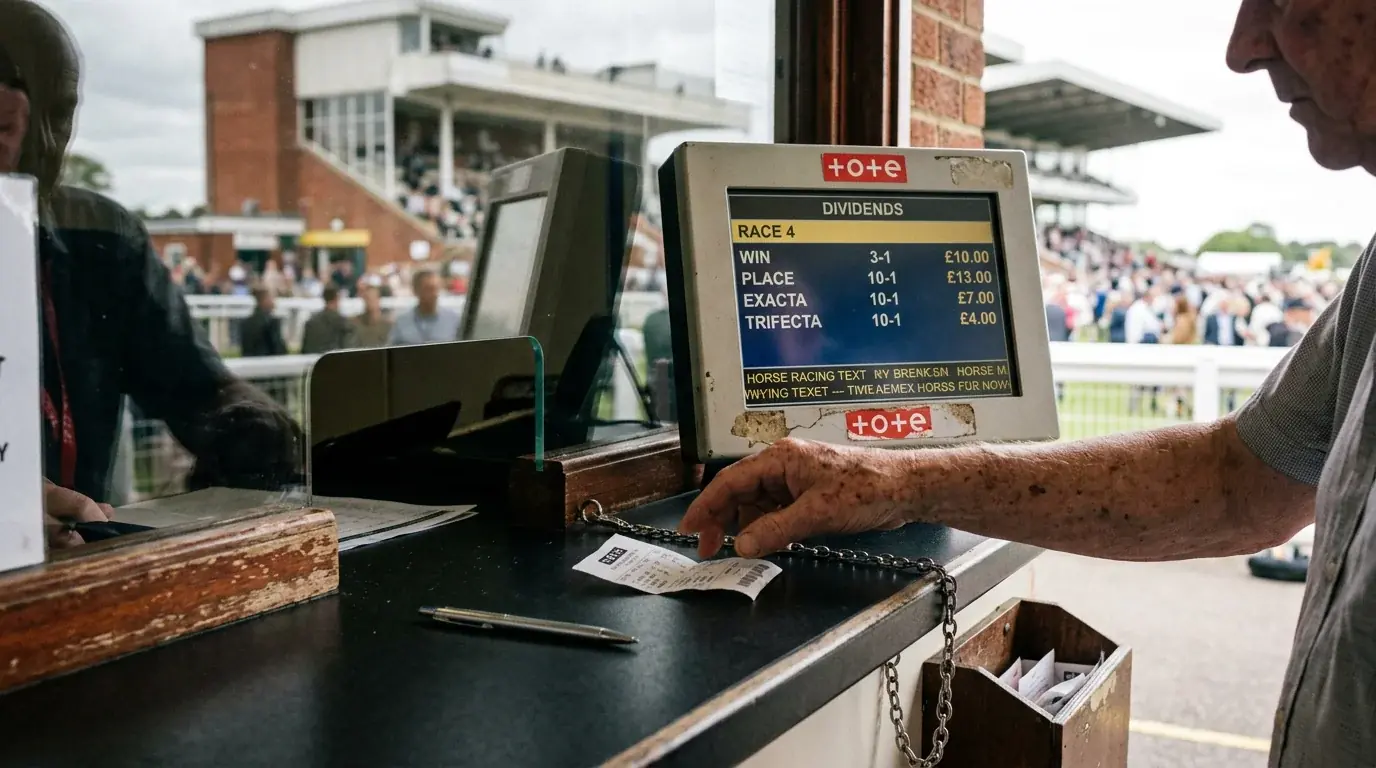
Tote pool betting contributes to racing funding through a different mechanism than the fixed-odds Levy. The Tote pays a contribution to UK racing as part of the operating licence structure of its commercial arrangement with racecourses. The mechanism produces meaningful annual contributions but is structurally separate from the HBLB Levy framework. Both streams feed into the overall racing funding picture but through different routes.
Created by the ”Best Betting Horse Racing” editorial team.